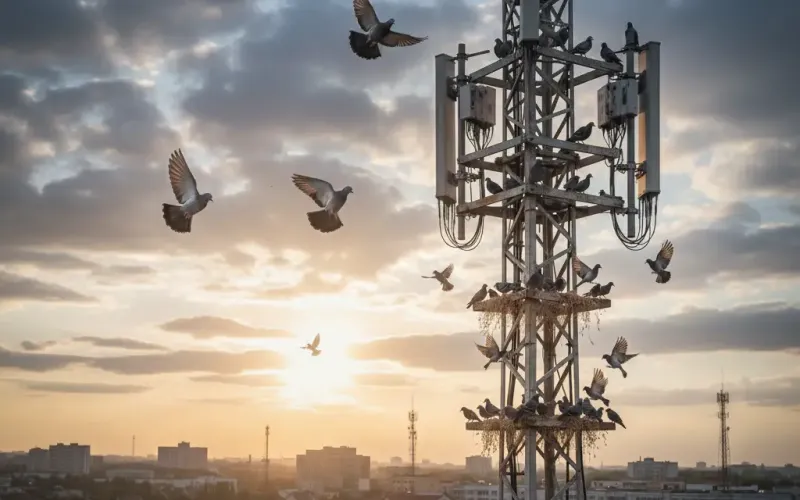
Telecommunications towers, broadcast masts, and vertical infrastructure attract birds naturally. Height, limited human presence, and structural complexity create ideal roosting conditions. For tower companies, bird activity becomes most visible during routine maintenance cycles, when technicians encounter nests, droppings, and debris that complicate scheduled work.
What looks like a wildlife issue quickly becomes a safety, scheduling, and cost problem.
Quick Answer: Bird control is challenging for tower companies because birds use elevated, low-disturbance structures for roosting and nesting. During routine maintenance cycles, nests, droppings, debris, and protected-species concerns can delay technicians, increase safety risks, disrupt schedules, and create unpredictable maintenance costs.
Reduce Bird-Related Tower Maintenance Disruptions
If birds keep returning to tower crossarms, braces, antenna mounts, platforms, cables, or junction points, Symterra can help assess the structure and recommend a long-term deterrent strategy built around tower layout and bird behavior.
Request a Site RecommendationTower Bird Maintenance Impact Table
| Tower bird control challenge | Maintenance impact |
|---|---|
| Nests on crossarms and braces | Crews may need removal, documentation, or rescheduling before work continues. |
| Droppings on ladders and platforms | Technician access can become slower and less safe. |
| Debris near antennas and cables | Inspection and servicing can take longer. |
| Activity near junction points | Equipment checks may require cleanup before technicians proceed. |
| Protected species concerns | Maintenance may require legal or environmental coordination. |
| Birds returning between visits | Crews face the same issue every quarter or year. |
| Partial deterrent coverage | Birds shift to untreated sections of the tower. |
| Extended labor time | Maintenance budgets become less predictable across tower portfolios. |
Why Towers Attract Persistent Bird Activity
Elevated Perching Zones
Towers provide high vantage points that protect birds from ground predators. Crossarms, antenna mounts, and structural braces offer stable landing areas.
Limited Daily Disturbance
Unlike ground-level facilities, towers are accessed only during inspections or upgrades. Birds learn these quiet patterns and treat towers as safe territory.
How Bird Activity Disrupts Routine Maintenance
Nest Removal Delays Scheduled Work
Active nests must be handled before technicians can proceed. This adds time, documentation, and in some cases, legal coordination if nesting involves protected species.
Increased Safety Risk for Technicians
Droppings on ladders, platforms, and braces reduce traction. Nest debris can obstruct safe climbing paths.
Equipment Contamination
Feathers, nesting material, and droppings accumulate near antennas, cables, and junction points, complicating inspection and servicing.
Compliance and Regulatory Complications
Wildlife Protection Considerations
Some bird species are protected by law. Routine maintenance becomes more complex when nesting intersects with environmental regulations.
Documentation Requirements
Technicians must log findings, pause work, and sometimes reschedule tasks, disrupting maintenance planning cycles.
Recurrent Nesting Creates Long-Term Planning Challenges
Repeat Site Visits
If deterrence is inconsistent, birds return between maintenance cycles. Crews face the same nesting issues every quarter or year.
Budget Variability
Unexpected nest removal, safety mitigation, and extended labor time distort maintenance cost forecasts across tower portfolios.
Why Temporary Measures Fall Short on Towers
Partial Coverage Leaves Structural Gaps
Towers have complex geometries. Static or incomplete deterrent placement leaves sections vulnerable.
Predictable Quiet Periods Invite Retesting
Birds quickly learn that maintenance activity is temporary. Once crews leave, birds return.
Why Tower Bird Prevention Needs Full-Structure Coverage
Tower bird prevention needs full-structure coverage because birds can move between crossarms, antenna mounts, braces, platforms, cables, junction points, and quiet structural pockets. If only the most visible nesting area is treated, birds may shift to another stable section after crews leave.
For tower companies, incomplete coverage can lead to repeat site visits, technician delays, safety concerns, equipment contamination, documentation work, and unpredictable maintenance costs. A long-term deterrent strategy should account for the full vertical structure, not only the first area where birds are found.
Tower operators can also review Symterra’s solutions for utility, signal, and power transmission towers where recurring bird activity can affect access, inspections, equipment areas, and maintenance cycles.
Stable Maintenance Cycles Require Continuous Prevention
For tower companies, bird control is not just about wildlife management. It affects technician safety, scheduling accuracy, regulatory compliance, and cost stability. When nesting recurs, routine maintenance becomes unpredictable.
Symterra Pulse supports tower infrastructure by providing real-time visibility into deterrent system performance. It helps identify weak zones and inactive sections before birds reestablish nesting patterns. With continuous, verified deterrence, tower companies reduce repeat disruptions and maintain predictable maintenance cycles.
Learn more about how Symterra’s bird deterrent system works to support behavior-based prevention across complex tower structures.
For more background on system performance, review Symterra’s efficacy study.
Need to reduce bird-related tower maintenance delays? Request a Symterra site recommendation to reduce repeat nesting, technician access issues, equipment contamination, and unpredictable maintenance cycles.
Frequently Asked Questions About Bird Control for Tower Companies
Why do birds nest on telecommunications and utility towers?
Birds nest on telecommunications and utility towers because the structures provide height, stability, limited human activity, and protected places such as crossarms, braces, antenna mounts, and platforms. These conditions can make towers feel like safe territory.
How does bird activity delay tower maintenance?
Bird activity delays tower maintenance when technicians must handle nests, droppings, debris, safety hazards, documentation, or protected-species concerns before completing scheduled inspection or repair work.
Why do birds return between tower maintenance cycles?
Birds return between tower maintenance cycles because towers are quiet for long periods between inspections. Once crews leave, birds may retest the same crossarms, braces, antenna mounts, and structural gaps.
What tower areas are most at risk for bird activity?
High-risk tower areas include crossarms, braces, antenna mounts, platforms, ladders, cables, junction points, and other elevated low-disturbance zones where birds can perch, roost, or nest.
How can tower companies reduce repeat bird maintenance issues?
Tower companies can reduce repeat bird maintenance issues by identifying active nesting and roosting zones, using consistent deterrent coverage across the full structure, and monitoring weak zones before birds reestablish activity.