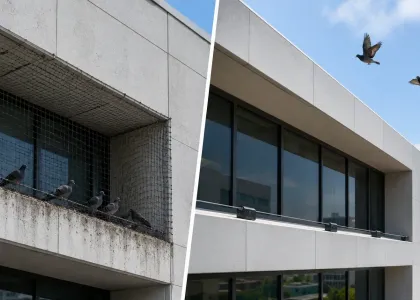
Many bird control strategies are designed around structures rather than behavior. Planners focus on installing deterrents in visible locations or responding after problems appear. While these efforts may reduce bird activity temporarily, they often fail to produce lasting results.
The reason is simple: birds adapt quickly. Without understanding how birds evaluate, test, and occupy structures, traditional deterrent planning leaves gaps that birds exploit.
Quick Answer: Why do traditional bird deterrent plans fail?
Traditional bird deterrent plans fail when they focus only on visible problem areas instead of how birds behave. Birds test landing zones, adapt to predictable deterrents, relocate to untreated areas, and return when maintenance activity stops. Long-term bird control needs a behavior-based plan that affects landing decisions across the full site.
Birds Continuously Evaluate Their Environment
Landing Zones Are Constantly Tested
Birds rarely commit to a location immediately. They test surfaces repeatedly to determine stability and safety.
Structures Provide Multiple Options
Beams, ledges, equipment mounts, and lighting fixtures offer many possible perching locations. If one area becomes uncomfortable, birds simply shift to another.
Adaptation Weakens Static Deterrents
Predictable Systems Lose Influence
When deterrents remain unchanged, birds learn that the environment does not pose a real threat. Over time, they ignore visual or noise-based deterrents.
Partial Coverage Encourages Relocation

Traditional planning often protects only the most visible areas. Birds respond by relocating within the same structure rather than leaving entirely.
Why Birds Return After Deterrents Are Installed
Birds return after deterrents are installed because they keep testing the site. If one landing zone becomes uncomfortable but nearby beams, ledges, signs, lights, or rooftop equipment remain available, birds often relocate instead of leaving.
This is why partial deterrent coverage creates weak results. The facility may look protected in the most visible areas, but birds still find quiet, stable, and untreated surfaces nearby.
Common reasons birds return include:
- Deterrents only cover one visible problem area
- Birds find nearby untreated ledges or beams
- Visual or sound deterrents become predictable
- Cleanup removes droppings but does not change site conditions
- Maintenance activity stops after installation
- Birds still find shelter, food, or safe landing zones
Traditional Bird Deterrents vs Behavior-Based Planning
| Planning Approach | What It Focuses On | Common Weakness | Better Long-Term Goal |
|---|---|---|---|
| Visual deterrents | Scaring birds away | Birds adapt when patterns do not change | Influence landing behavior consistently |
| Noise devices | Creating disturbance | Birds learn when sound poses no threat | Reduce predictable patterns |
| Spikes and barriers | Blocking specific surfaces | Birds move to nearby untreated areas | Cover all high-risk zones |
| Cleanup-only planning | Removing droppings and nests | Does not change why birds return | Prevent repeated occupation |
| Behavior-based planning | How birds test, adapt, and relocate | Needs full-site evaluation | Make the site less comfortable to occupy |
Need a bird deterrent plan that accounts for bird behavior?
Symterra helps commercial facilities move beyond reactive cleanup and static deterrents by evaluating how birds land, adapt, relocate, and return across the full property.
Request a Site RecommendationBirds Learn Maintenance Patterns
Temporary Disturbance Is Recognized
Birds observe when technicians visit and when the site becomes quiet again. Once the disturbance passes, birds retest the structure.
Quiet Structures Reinforce Occupation
Facilities with predictable maintenance cycles and long quiet periods provide ideal conditions for repeated roosting.
Traditional Planning Often Focuses on Cleanup
Nest Removal Is Treated as the Solution
Removing nests clears visible evidence but does not change how birds perceive the site.
Cleaning Masks Ongoing Risk
After surfaces are cleaned, the structure still offers the same comfortable landing conditions.
Why Commercial Sites Need Behavior-Based Bird Control
Commercial properties often have many possible bird activity zones. Birds may test signs, beams, rooftops, vents, lighting fixtures, canopies, loading docks, and equipment mounts before choosing where to settle.
Traditional deterrent planning often fails because it treats the first visible problem as the full problem. In reality, birds use the whole structure. If one area becomes uncomfortable, they search for another stable surface nearby.
A behavior-based bird control plan helps facility teams identify:
- Where birds are landing
- Where birds may relocate
- Which areas need wider coverage
- Which zones need ongoing performance visibility
- Whether the system continues working after installation
This approach gives facilities a better chance to reduce repeat cleanup, equipment damage, and recurring bird pressure.
Behavior-Aware Planning Improves Deterrence
Deterrence Must Affect Landing Decisions
When birds experience consistent discomfort or instability during landing attempts, they reassess the structure.
Complete Coverage Prevents Internal Relocation
Protecting all high-risk zones eliminates the opportunity for birds to shift within the same structure.
Effective Planning Requires Understanding Behavior
Traditional deterrent planning fails when it overlooks how birds adapt to their environment. Lasting control requires systems that consistently influence landing behavior and remove comfortable roosting opportunities.
Symterra Pulse supports behavior-aware deterrent planning by providing real-time visibility into system performance. It helps facilities detect inactive zones and system faults before birds reclaim those areas. With verified deterrence in place, bird control strategies remain effective over time.
Stop planning bird control around guesswork
If birds keep returning after cleanup, spikes, netting, or visual deterrents, Symterra can help evaluate your site and recommend a long-term deterrent approach based on how birds actually behave.
Schedule a ConsultationFrequently Asked Questions
Why do traditional bird deterrent plans often fail?
Traditional bird deterrent plans often fail because they focus on the structure instead of the bird’s behavior. Many strategies only address visible problem areas or react after birds have already settled. This creates gaps that birds quickly learn to use.
How do birds evaluate a structure before staying?
Birds usually do not commit to a location right away. They test landing spots multiple times to see whether the surface feels stable, safe, and usable. If the structure continues to feel comfortable, they return and build a pattern of occupation.
Why is partial deterrent coverage a problem?
Partial coverage leaves untreated areas open for relocation. If one ledge, beam, or fixture becomes difficult to use, birds often move to another part of the same structure. This means the problem shifts instead of disappearing.
Why do static deterrents lose effectiveness over time?
Static deterrents lose effectiveness because birds adapt to patterns that do not change. Visual decoys, noise devices, and other predictable tools stop influencing behavior once birds realize there is no real threat. Over time, they ignore the deterrent and return.