Quick Answer
How do you get rid of starlings and keep them from coming back?
The best way to get rid of starlings is to remove food sources, clear nesting material where allowed, block vents and gaps, protect high-use landing areas, and use a long-term deterrent strategy that makes the property less suitable for repeat roosting and nesting. Spikes, netting, and sound devices can help in specific zones, but commercial properties usually need consistent, behavior-based deterrence to stop starlings from returning.
Starling Control Methods Compared
| Starling control method | Best use | Limitation | Long-term value |
|---|---|---|---|
| Food source removal | Reducing daily starling attraction | Requires consistent sanitation and waste control | Strong first step |
| Nest removal where permitted | Removing old nesting cues | Does not stop future nesting by itself | Useful with follow-up prevention |
| Vent and gap exclusion | Blocking nesting access points | Small gaps can reduce performance | Strong for nesting prevention |
| Bird spikes | Ledges, beams, signs, and narrow landing zones | Birds may shift to nearby untreated surfaces | Limited for full-property control |
| Bird netting | Rafters, loading docks, and open structural areas | Requires proper installation and maintenance | Strong for defined exclusion zones |
| Sound or visual deterrents | Short-term movement or disruption | Starlings can adapt when tools become predictable | Weak when used alone |
| Symterra Pulse | Commercial sites with repeated bird pressure | Works best when planned around full site layout | Strong for long-term prevention |
Starlings do not show up by accident. They find shelter, test the area, and stay when the environment works for them. Once they settle in, they create noise, mess, nesting problems, and repeat return activity that gets harder to stop over time.
If you want to get rid of starlings, you need more than a quick fix. You need a strategy that removes what attracts them, blocks where they land or nest, and makes the property uncomfortable for them long term.
That is exactly the approach Symterra focuses on. Instead of short-term fixes, the goal is to change the environment so birds stop choosing your property in the first place.
Starling Deterrent Assessment
Need Starlings to Stop Coming Back?
If starlings keep returning to vents, rooflines, gutters, signs, ledges, loading areas, or commercial structures, Symterra can help assess the site and recommend a long-term deterrent strategy built around bird behavior and property layout.
Request a Starling Deterrent AssessmentWhy Starlings Keep Returning
Starlings keep returning because they remember locations that gave them shelter, warmth, food, and safe nesting space. Once a property works for them, they often test the same ledges, vents, gutters, signs, rooflines, and equipment areas again.
Short-term deterrents usually fail because they do not remove the reason starlings chose the property. Fake predators, noise devices, reflective tape, and partial barriers may move them for a short time, but they often adapt or shift to another nearby landing zone.
The best control plan targets the full behavior pattern. That means removing attractants, blocking nesting access, and using a long-term humane deterrent strategy that makes the property less suitable for repeat bird activity.
Why Starlings Return to the Same Structures
Starlings return to the same structures because they remember places that gave them shelter, warmth, food access, and safe nesting opportunities. Once a roofline, vent, sign, gutter, ledge, loading area, or equipment zone works for them, they may test it again during the next roosting or nesting cycle.
This is why one-time cleanup often fails. Removing droppings or nesting material may clear the visible problem, but it does not change the structure that attracted the birds. If food remains nearby, gaps stay open, or ledges still provide stable landing areas, starlings have a reason to return.
A stronger control plan focuses on the full pattern of behavior. It should identify where starlings land, where they gather, where they nest, and which areas they keep testing after deterrents are installed.
Non-Lethal Starling Control Options Compared
| Control Option | Best Use | Limitation |
|---|---|---|
| Sanitation and food removal | Reducing what attracts starlings | Needs regular upkeep |
| Nest removal where permitted | Clearing old nesting cues | Does not stop future nesting by itself |
| Vent and gap exclusion | Blocking nesting access | Small gaps reduce performance |
| Spikes or netting | Protecting specific landing zones | Can push birds to nearby areas |
| Symterra Pulse | Long-term property-wide deterrence | Works best after site conditions are reviewed |
Commercial vs. Residential Starling Control
Residential starling problems usually involve small nesting areas, gutters, vents, or roof edges. Commercial starling problems are different because they often involve larger surfaces, repeated landing zones, high rooflines, signs, loading areas, and equipment spaces.
For businesses, the concern is not only the presence of starlings. The bigger issue is the operational risk they create through droppings, nesting debris, blocked vents, equipment damage, and repeat cleanup.
That is why commercial properties need a prevention strategy instead of a one-time removal approach.
If starlings are leaving droppings around walkways, equipment, or service areas, review the health and safety risks of bird droppings before treating the issue as simple cleanup.
Long-Term Starling Prevention for Commercial Properties
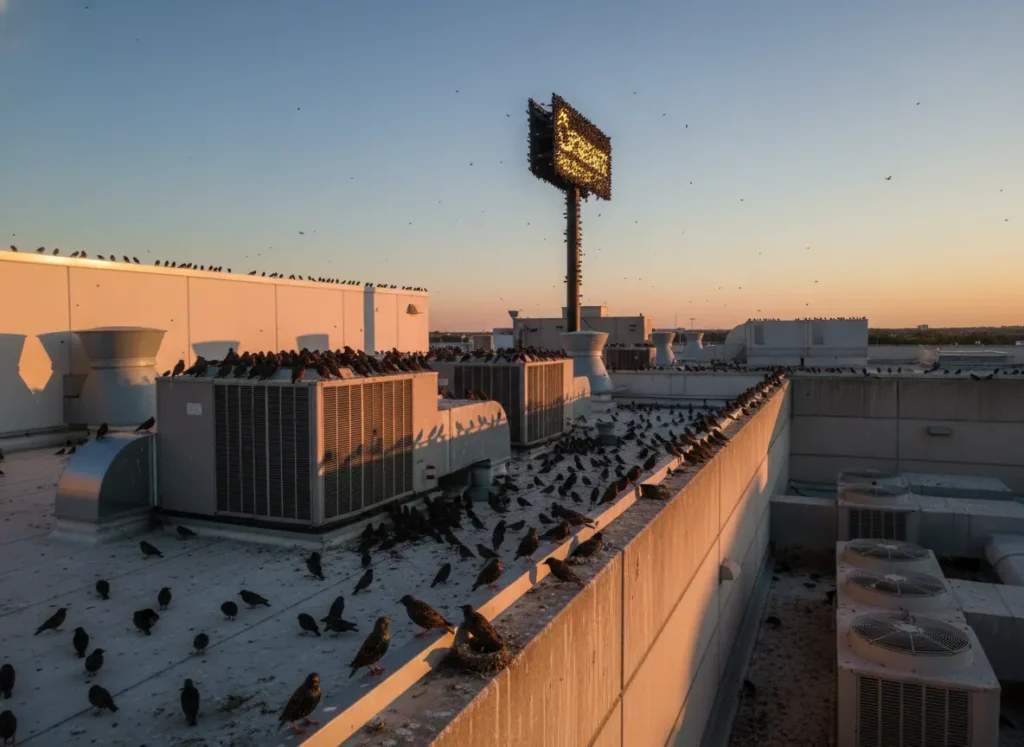
Commercial properties need long-term starling prevention because the problem often spreads across more than one area. Starlings may move between rooflines, signs, vents, loading docks, gutters, warehouse rafters, equipment enclosures, and sheltered structural pockets.
For facility teams, repeat starling activity can create droppings, odor, nesting debris, clogged drains, blocked vents, equipment access issues, and recurring cleanup costs. A long-term prevention plan should do more than remove the birds once. It should make the property less useful for roosting, nesting, and gathering over time.
The best approach is layered. Remove attractants, close nesting access, protect high-use zones, and use consistent deterrent coverage across the areas starlings keep testing. For broader protection, review the Symterra Bird Deterrent System and how it supports long-term commercial bird prevention.
Why Starlings Become a Bigger Problem So Fast
Starlings are not solitary birds. They gather in groups, follow proven nesting patterns, and return to places that gave them shelter before. That is why a small bird issue can turn into a large infestation faster than many property owners expect.
Once starlings claim an area, they often spread across rooftops, ledges, vents, signs, gutters, loading zones, and equipment enclosures. They do not stay in one corner. They move through the parts of the property that give them warmth, cover, and easy access.
This is one reason starling control gets harder once the birds establish a routine. You are no longer dealing with random activity. You are dealing with a repeated behavior pattern.
Why Starlings Are More Than a Nuisance
Many people think the main problem is droppings. That is only part of it.
Starlings create operational issues that affect safety, maintenance, equipment, and public perception. Their droppings create slippery surfaces on walkways, ramps, and entry points. Their nesting materials clog drains and gutters. Debris can build near electrical systems, rooftop units, or other sensitive infrastructure. Over time, the mess, odor, and visible bird activity also affect how people experience the property.
In commercial and industrial settings, the issue gets more serious. Property teams lose time dealing with repeated cleanup. Maintenance becomes reactive instead of planned. Customers, tenants, or staff notice the condition of the building. What started as a bird problem becomes an operations problem.
Why Most DIY Bird Control Methods Fail
This is where a lot of people waste time and money.
They buy a visual scare tool, install a few spikes, or try a sound device and expect the birds to disappear. The problem is starlings adapt fast. If the solution is weak, inconsistent, or only covers one small section of the property, the birds adjust and stay.
Fake predators often stop working after birds realize there is no real threat. Reflective materials and noise devices may cause a short reaction at first, but starlings often get used to them. Poorly installed spikes leave surrounding landing zones open. Manual nest removal without follow-up only treats the symptom, not the reason the birds chose the site.
The truth is simple. If your method does not change the environment in a lasting way, it usually does not last.
What Actually Works to Get Rid of Starlings
The most effective way to remove starlings is to use a layered strategy. No single product fixes every situation. Real bird control works when you address attraction points, nesting access, and long-term deterrence together.
Remove What Attracts Them
Start with the reason the birds are there.
Inspect the property for nesting debris, food waste, standing water, protected ledges, vent openings, and gaps where birds can enter or settle. Clear old nests where permitted, remove buildup in gutters and drains, improve sanitation around food-related zones, and reduce easy access to sheltered areas.
If the property still offers what the birds want, they will keep trying to return.
This step aligns with how Symterra approaches bird control. You eliminate the conditions first before applying deterrents.
Block the Areas They Use Most
Physical exclusion still matters. In many environments, it is one of the most practical first steps.
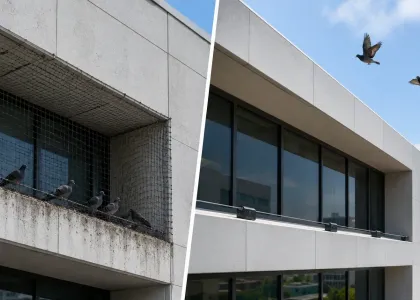
Bird netting works well in larger overhead or open-frame areas. Spikes can help on ledges, beams, signage, and narrow landing zones. Sealing gaps around vents, roof edges, and structural openings helps cut off nesting access.
This step is useful, but it works best when applied carefully and completely. Partial coverage often pushes birds a few feet over instead of off the property.
Use a Long-Term Deterrent That Does Not Fade Quickly
This is where many bird control plans either hold up or fall apart.
Starlings do not leave just because something looks different for a day or two. Long-term results come from making the site feel unreliable and unsuitable for settlement. That is why property-wide deterrence matters, especially for commercial buildings, rooftops, industrial sites, and other large facilities.
A system like Symterra Pulse is designed for this type of challenge. Instead of relying only on visible scare tactics or one-point barriers, it works by changing how birds experience the environment. Learn more about Symterra Pulse and how it supports long-term bird deterrence for commercial properties.
For properties dealing with repeated bird pressure, this type of solution helps reduce the need for constant manual intervention.
Combine Methods Instead of Relying on One
The strongest results usually come from combining multiple methods with a clear purpose behind each one.
Cleanup removes attraction.
Exclusion blocks access.
Property-wide deterrence reduces repeat settlement.
That combination is what makes control last longer. Without that structure, bird problems often come back in cycles.
This layered strategy reflects how Symterra designs solutions for commercial and industrial environments.
Where Starlings Usually Nest and Gather
If you are trying to solve the problem fast, focus on the highest-risk zones first.
Common starling hotspots include:
- Rooftop HVAC units
- Gutters and drainage edges
- Loading docks
- Warehouse rafters
- Exterior signs and ledges
- Vents and utility openings
- Covered entry areas
- Structural cavities and sheltered beams
These areas matter because they offer height, protection, heat, and a sense of safety. Once you know where the birds are using the property, your control strategy gets sharper.
What Does Not Work Well Long Term
Some methods look useful because they are cheap or easy to install. That does not mean they solve the problem.
Short-term or weak solutions often include fake owls, reflective tape, occasional sound devices, and isolated manual cleanup without follow-up. These methods might create temporary movement, but they rarely remove the conditions that make the site attractive.
The birds often shift position, wait it out, or return after a few days.
That is the trap. It feels like progress, but it is usually a pause.
How to Keep Starlings From Coming Back
Removing starlings is only one part of the job. Prevention is what keeps the issue from resetting every season.
The best way to prevent return activity is to inspect the property regularly, remove early nesting attempts fast, maintain exclusion tools, and keep deterrent coverage consistent. Problem areas like rooftop equipment, drainage zones, and ledges should stay on a regular inspection list.
Starlings are repeat birds. If a location worked once, they often try it again.
Your goal is to make sure it never works the same way twice. For a deeper prevention-focused guide, read how to get rid of starlings and keep them from coming back.
When Professional Starling Control Makes Sense
If the infestation covers multiple zones, keeps coming back, or affects a large commercial or industrial property, a one-off fix is usually not enough.
At that point, the better move is a professional bird control strategy that looks at the whole property, not just the most visible mess. That includes the nesting zones, structural risk points, repeated access paths, and the deterrence method best suited for the size and type of site.
For facilities dealing with ongoing bird pressure, a scalable approach from Symterra helps shift bird control from reactive cleanup to proactive prevention.
Stop Starlings Before They Become a Recurring Facility Problem
If starlings keep returning to your roofline, vents, ledges, signs, or loading areas, the issue is no longer a one-time nuisance. It is a repeat behavior pattern.
Symterra helps commercial and industrial properties reduce bird pressure with long-term deterrent strategies built around the way birds choose, test, and reuse safe locations.
Contact Symterra to assess your site and build a starling control plan that prevents repeat activity.
Long-Term Starling Prevention
Stop Starlings Before They Return Again
If starlings keep coming back to your roofline, vents, ledges, signs, loading areas, or equipment zones, Symterra Pulse helps reduce repeat bird pressure with a non-lethal deterrent system built for long-term prevention.
Request a Site AssessmentFinal Thoughts
If you are asking how to get rid of starlings, the honest answer is this: the best results come from a layered system, not a gimmick.
You need to remove what attracts them, shut down the spaces they use, and apply a deterrent approach that holds up over time. Anything less usually turns into repeat cleanup, repeat nesting, and the same headache on loop.
Starlings stay where the environment works.
Change the environment, and you change the result.
That is the core idea behind Symterra. Instead of reacting to bird activity after it happens, the focus is on preventing it at the source with a structured, long-term approach.