Quick Answer
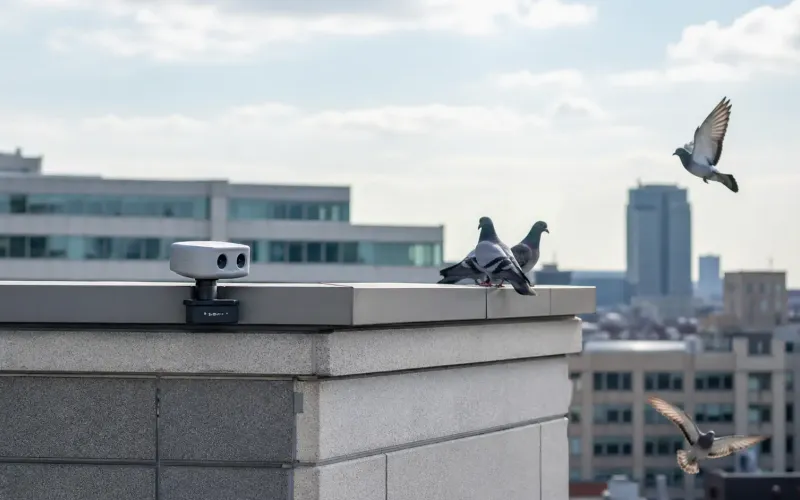
Ultrasonic bird repellers may create short-term disturbance, but they often lose effectiveness because birds adapt to repeated sounds that do not create a real reason to leave. For commercial properties, ultrasonic devices usually fall short because they do not address why birds keep landing, roosting, or nesting in the area.
A stronger option is a behavior-based bird deterrent system like Symterra Pulse, which is designed for recurring bird pressure on rooftops, signs, ledges, utility structures, warehouses, and other commercial sites.
You have seen them on Amazon. Small plastic boxes promising to drive birds away with sound waves humans cannot hear. The pitch is clean: install it, forget it, birds gone.
The science says otherwise.
This post breaks down what ultrasonic bird repellers actually do, what the research shows, and why facilities dealing with a real bird problem need to stop waiting for a gadget to fix it.
Need a Better Option Than Ultrasonic Bird Repellers?
If ultrasonic devices, fake owls, or visual deterrents have not solved the problem, it may be time for a behavior-based bird control system.
Symterra Pulse helps commercial properties reduce recurring bird pressure with a non-lethal deterrent system designed for rooftops, signs, ledges, towers, warehouses, and other high-risk areas.
Why Ultrasonic Bird Repellers Often Fail
Ultrasonic bird repellers depend on sound to make birds uncomfortable. The problem is simple. Birds often learn that the sound does not create danger, block access, or change the area they want to use.
Once birds realize the device is predictable, they ignore it.
This is why many property owners see early activity reduction, then the birds come back. The device may still be running, but the birds no longer treat it as a threat.
For commercial properties, this creates a bigger issue. The real problem is not only bird activity. It is repeated cleanup, property damage, blocked signage, nesting, maintenance calls, and lost time.
Ultrasonic Repellers vs Visual Deterrents vs Pulse-Based Deterrents
| Deterrent Type | How It Works | Common Limitation | Best Use |
|---|---|---|---|
| Ultrasonic repellers | Emit high-frequency sound intended to disturb birds | Birds often adapt when the sound becomes predictable or harmless | Small areas with light, temporary bird activity |
| Visual deterrents | Use reflective tape, fake predators, flags, or moving objects | Birds learn the object is not a real threat | Short-term support in open areas |
| Noise makers | Use distress calls, alarms, or loud sounds | Repeated sound patterns lose impact over time | Temporary bird pressure in controlled settings |
| Spikes and physical barriers | Block birds from landing on narrow surfaces | Birds may move to nearby untreated areas | Ledges, beams, signs, and narrow landing points |
| Pulse-based deterrents | Use a behavior-based system to discourage landing and roosting | Requires proper site assessment and placement | Commercial buildings, rooftops, signage, towers, warehouses, and recurring bird pressure areas |
Why Birds Adapt to Predictable Deterrents
Birds learn fast.
If a sound, light, object, or movement repeats without consequence, birds begin to treat it as background noise. This process is called habituation.
At first, birds may hesitate. Then they test the area. If nothing happens, they return. Over time, the deterrent becomes part of the environment.
That is why birds often ignore:
- Ultrasonic devices
- Fake owls
- Reflective tape
- Repeating sound machines
- Static scare devices
- Lights with fixed timing
Long-term bird control needs more than a scare tactic. It needs a system that changes how birds respond to the site.
When Commercial Properties Need More Than Ultrasonic Devices
Ultrasonic bird repellers are not enough when birds keep returning to the same areas.
This is common on:
- Commercial rooftops
- Billboards and signs
- Utility towers
- Warehouses
- Food processing facilities
- Stadiums and venues
- Loading docks
- Parking structures
- Agricultural sites
In these locations, birds are not passing through randomly. They return because the site offers shelter, height, food access, nesting space, or safe roosting.
A stronger bird control plan starts by identifying why birds choose the site, then applying a deterrent system to the areas with the most bird pressure.
What Is an Ultrasonic Bird Repeller?
Ultrasonic bird repellers are devices that emit high-frequency sound waves, typically between 15 and 25 kHz, above the range of human hearing. The idea is that these frequencies are uncomfortable enough to drive birds away from an area without making noise that bothers people nearby.
The concept sounds reasonable. The execution is where it falls apart.
Why Most Birds Cannot Hear Them
Here is the core problem. Most birds hear best around 1 to 5 kHz and have very poor sensitivity above roughly 10 kHz. Ultrasonic devices operate well above that ceiling.
The scientific research consistently shows that most pest birds simply cannot detect true ultrasonic frequencies above 20 kHz. The most common problem species, pigeons, starlings, sparrows, crows, are the exact birds that fall outside the range these devices target.
The only thing ultrasonic bird repeller devices reliably disturb is dogs and cats, which can hear higher frequencies. The birds you are trying to move are largely unaffected.
What the Studies Actually Found
Pigeons Ignored the Devices Entirely
One study mounted an ultrasonic speaker at a dovecote entrance and observed pigeon behavior across on and off cycles of the device. Pigeons used the entrance regularly regardless of whether the device was running, and no deterrent effect was seen. Blood samples also showed no stress response during ultrasonic exposure.
Gulls Did Not Respond to Ultrasound Either
In a field test at a municipal treatment plant with large gull populations, researchers placed sound sources close to birds and broadcast ultrasound at high intensities. Ultrasound and infrasound did not produce a scaring effect. Only certain frequency modulated audible signals affected gull behaviour.
Government Reviews Reached the Same Conclusion
A government evaluation of bird control products for airports concluded that ultrasound is not an effective bird deterrent and is not recommended for airport wildlife control.
The Habituation Problem
Even in cases where a device produces some initial disruption, it does not last. Habituation occurs quickly in many cases, with birds returning to treated areas within days or weeks of initial installation.
Birds are wired to assess and adapt to threats. A sound that carries no consequence teaches them there is no consequence. A continuous, fixed-frequency tone accelerates that adaptation because the birds learn nothing ever follows the signal. Fixed-frequency repellers are the most likely to trigger rapid habituation, and they are also the cheapest and most widely sold.
Looking for a Better Option Than Ultrasonic Repellers?
Symterra Pulse helps commercial properties reduce bird pressure with a non-harmful, behavior-based deterrent system designed for problem landing and roosting areas.
Learn About Symterra PulseWhy Manufacturers Can Get Away With These Claims
Conflict of Interest in the Research
Independent studies consistently show lower effectiveness ratings than those funded by companies selling ultrasonic devices. When a brand sponsors its own efficacy study, the results tend to look better than what shows up in peer-reviewed, independent research.
The FTC Has Noticed
The Federal Trade Commission has issued multiple warnings and taken enforcement actions against companies making unsubstantiated claims about ultrasonic repeller effectiveness. The regulatory position is clear: manufacturers must have solid scientific evidence to back up effectiveness claims.
Seeing a product on a shelf or in a top Amazon result does not mean the claims on the box are legitimate.
Where Ultrasonic Devices Fall Short for Commercial Facilities
Limited Coverage Area
Sound waves do not travel effectively around corners, walls, or large open spaces. A single unit covering a warehouse bay, a cell tower platform, or a rooftop HVAC cluster is not going to produce consistent results across the full structure.
Weather Reduces Performance
Outdoor use is affected by wind, rain, and background noise. In industrial and agricultural settings, ambient noise alone can overwhelm the output of a consumer-grade device.
They Do Not Address Why Birds Are There
Birds do not land on a warehouse roof or a billboard structure at random. They are there because the site offers something: shelter, a safe roost, proximity to food, or an elevated vantage point. An ultrasonic device does nothing to change that. The birds have no reason to leave because there is no actual threat.
What Actually Works for Commercial Bird Problems
The research is consistent on this point. Sound-based deterrence that works uses audible frequencies, not ultrasonic ones. Complex sound waves are more effective at repelling birds than a single audio mode. Distress calls, predator vocalizations, and variable frequency patterns tied to real biological threat signals produce measurable behavioral change because they mean something to the bird.
Beyond acoustics, the evidence points toward systems that disrupt the biological reasons birds choose a site in the first place. When a bird understands a location is unsafe, the flock communicates that signal and avoids the area. That is the mechanism that produces lasting deterrence, not a device emitting frequencies they cannot hear.
The Bottom Line
Ultrasonic bird repellers fail at the most fundamental level: most pest birds cannot hear them. The frequencies are wrong, the research is clear, and the few short-term results that do appear in studies collapse within days as birds adapt.
For a homeowner dealing with two pigeons on a balcony, a cheap device might produce a few days of relief. For a telecom facility, a food processing plant, a warehouse, or an agricultural operation dealing with real liability, compliance pressure, and ongoing damage, these devices are not a solution. They are a delay.
The bird problem does not go away because a box is plugged in. It goes away when you give birds a real biological reason to stop coming back.
Frequently Asked Questions
Do ultrasonic bird repellers work?
Ultrasonic bird repellers may create short-term disturbance, but they often fail long term because birds adapt to repeated sounds that do not create a real threat or block access.
Do ultrasonic bird repellers work on pigeons?
Ultrasonic bird repellers are often unreliable for pigeons. Pigeons usually adapt quickly when a sound repeats without consequence.
Why do birds ignore ultrasonic devices?
Birds ignore ultrasonic devices when they learn the sound is predictable and harmless. Once birds realize the device does not change the area, they return.
What works better than ultrasonic bird repellers?
A behavior-based bird deterrent system often works better for commercial properties because it focuses on where birds land, why they return, and how to discourage repeated use of the site.
Are ultrasonic bird repellers good for commercial buildings?
Ultrasonic bird repellers are usually not ideal for commercial buildings with recurring bird pressure. Large structures often need a site-specific deterrent plan with stronger coverage.
What is the best alternative to ultrasonic bird repellers?
The best alternative depends on the property, but commercial sites often need a behavior-based system like Symterra Pulse instead of a simple sound device.