Seagulls are not pigeons. They are bigger, louder, more aggressive, and significantly harder to shift once they have decided a rooftop is home. They are also legally protected in most jurisdictions, which limits what you can and cannot do.
If you have seagulls nesting on your building or returning to the same rooftop every season, this is what you need to know.
Why Seagulls Choose Your Rooftop
Seagulls are naturally ground nesters, but large flat rooftops look like islands to them: elevated, open, with a clear sightline for predators and no ground-level threats. A commercial rooftop, especially a gravel or membrane roof, is nearly indistinguishable from the kind of coastal terrain they evolved to nest on.
Once one pair establishes a nest, others follow. Seagulls return to the same nesting site year after year, which means an untreated rooftop becomes a recurring problem every spring, not a one-time event.
The key to breaking this cycle is timing and the right combination of methods.
The Legal Reality You Have to Deal With
Before doing anything, understand the legal constraint: in most countries, active seagull nests containing eggs or chicks cannot be touched without a permit. Attempting to remove an active nest without proper authorization can result in fines.
This means timing matters enormously. Any deterrent system needs to be in place before nesting season begins in spring. Once birds are nesting, your options narrow significantly and you will be waiting out the season while the problem locks in for another year.
What Actually Works on Rooftops
Remove What Attracts Them First
No deterrent system performs well on a site that is still actively attractive to gulls. Seagulls come to a location for food, water, and shelter. Removing food sources is the first step. Secure all waste containers, clear food debris from loading areas, and eliminate standing water where possible.
If the site remains a reliable food source, birds will tolerate a significant amount of disruption to stay near it.
Physical Barriers for Ledges and Edges
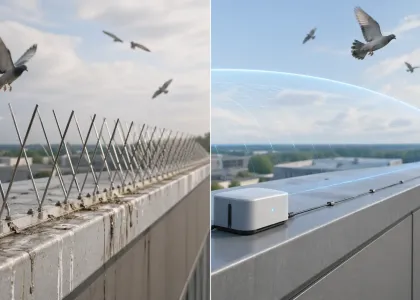
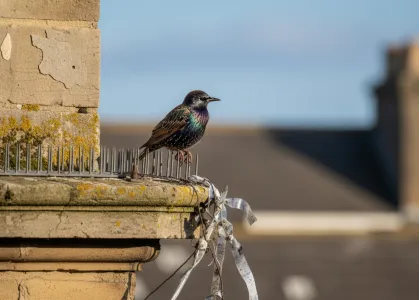
For narrow ledges, parapets, and roofline edges where gulls perch, large-format bird spikes are effective. Seagulls need a wide, stable landing surface. Spikes deny them that foothold without causing harm.
The installation requirements are strict. Coverage must be complete with no gaps, the base must bond cleanly to the surface, and the spike width needs to match the gull’s size. Narrow pigeon spikes are not sufficient for gulls.
Bird wire systems are another option for ledges and edges. Tensioned stainless steel wire mounted on posts creates an unstable landing surface. Gulls attempting to land find no solid footing and move on. Wire systems are more discreet than spikes and perform well on long roofline runs where aesthetic impact matters.
Grid Wire for Flat Rooftops
A flat commercial rooftop is too large to treat with ledge-mounted spikes. Grid deterrent wire, a series of posts with wire running across them at intervals, covers the open roof area and prevents gulls from descending onto the surface. This is one of the most effective approaches for large flat roofs that seagulls are using as a nesting ground.
Predator Presence and Biological Threat
Seagulls understand predators. The reason they chose your rooftop in the first place is that it seemed safe. Disrupting that perception is more effective than any physical barrier alone.
Falconry is used commercially for exactly this reason. A bird of prey operating on site at regular intervals teaches the gull flock that the location carries genuine risk. The birds do not just leave the treated ledge. They leave the site and communicate that it is unsafe to the flock.
For facilities where falconry is not practical, automated laser systems create the perception of a moving threat on the rooftop. Unlike static visual decoys, a laser that moves does not allow birds to habituate to it by recognizing it as harmless.
Distress call systems using audible predator calls or species-specific alarm signals can also disrupt gull behavior, but only when combined with physical deterrents. Gulls are intelligent and will test an audio signal against the actual conditions. If there is no physical barrier and no real threat ever follows the sound, they adapt within weeks.
Electromagnetic Deterrents for Established Flocks
For sites where gulls have strong site loyalty built over multiple seasons, disrupting access alone is often not enough. The flock returns because the biological signal that marks the location as a safe roost has not changed.
Electromagnetic deterrent systems work at that level. By interfering with the birds’ ability to read the site as safe through their magnetoreception, the system removes the biological comfort that brings them back. This is particularly relevant for commercial sites with persistent, multi-year gull problems where physical barriers have been tried and failed to hold.
What Does Not Work on Seagulls
Visual Decoys
Plastic owls, raptor kites, and reflective balloons produce a few days of disruption at best. Seagulls are intelligent enough to assess a static object and recognize it as harmless within a short period. Once they do, they ignore it entirely.
If a visual decoy is not moving unpredictably and producing no actual consequence, it stops working.
Ultrasonic Devices
As covered in the research, seagulls hear best in the 1 to 5 kHz range. Ultrasonic devices emit frequencies above what gulls can detect. They do not work on seagulls and are not recommended for gull control by any credible wildlife management authority.
Doing Nothing Until It Is Too Late
The single biggest mistake facilities make with seagulls is waiting until eggs are laid to act. At that point, legal protections apply, removal options are gone, and the problem is locked in until the chicks fledge. By then the flock has reinforced its site loyalty for another year.
The Right Approach
Seagull control on commercial rooftops requires action before nesting season, a combination of physical and behavioral deterrents, and for persistent infestations, a system that addresses why birds choose the site biologically, not just physically.
A single deterrent will not solve a seagull problem on an established commercial site. The facilities that get lasting results are the ones that remove the food source, block physical access, introduce a genuine threat perception, and then reinforce the location as unsafe at the biological level.
That combination gives the flock no reason to stay and no reason to come back.