Real Bird Problems are Real. Really Real. The names have been changed to protect the innocent.
Bird Control for Pest Bird Problems
As we’ve begun to introduce customers to bird control techniques and the Symterra technology, we’ve had NO SHORTAGE of stories about massive and multi-year bird infestations. Most common pest birds can be difficult to irradiate with typical pest management solutions. Once a bird problem begins, it simply won’t end on its own. We encounter many a client/prospect at their wit’s end.
Case Study: Pest Birds Take Over a Busy Dry Cleaner
A prominent and successful dry cleaner reached out to their local pest management professionals about how to deter birds at their largest and busiest location. The building has a canopied drop-off/pick up area typical at any number of dry cleaners (You can see it, right?).
As patrons, we probably don’t pay much attention to our surroundings while we make that quick stop to claim our laundry…unless…unless you must shuffle through piles of the bird feces and nesting materials of common pest birds in orders to get to your clean clothes.
Why Bird Spikes and Netting Failed
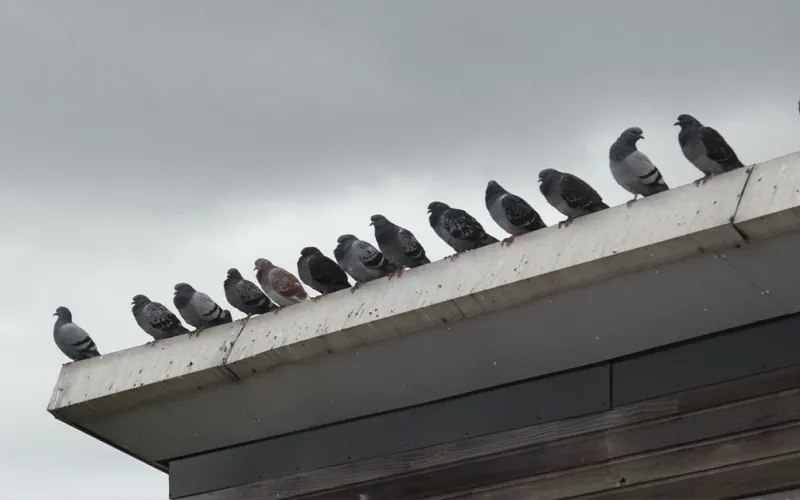
That is the bird problem. The canopy is inundated with nesting birds and bird droppings, all roosting in the bird spikes and chicken wire previously installed to keep them out. Despite business’ best intentions, common pest control meant to eradicate feral pigeons, such as installing bird netting and removing any objects that could be used as bird feeders, often leave much to be desired.
The owner of the dry cleaner laments the time and dollars spent over the last few years to address the pest birds that never leave and continue to inundate their business with pest bird droppings despite all the efforts.
Why Traditional Bird Control Failed
The canopy structure created a perfect roosting zone. Bird spikes and chicken wire were installed, but they only addressed where birds landed, not why they stayed. The birds adapted by nesting between and on top of the deterrents, turning the control devices into part of the problem. Without disrupting the birds’ behavior or attachment to the site, the infestation continued year after year.
A Technology-Based Approach to Bird Infestation
Symterra is in a category of its own. The technology affects bird physiology. Birds never adapt to the system and will relocate themselves, always without harm.
With this advancement, business owners can humanely rid their structures of bird problems once and for all with an aesthetically pleasing, low-profile, and highly effective product that can be installed easily and will drastically outperform other solutions.
Patron safety, employee safety, risk management and protection of assets are all improved!
Frequently Asked Questions
What is a pest bird?
A pest bird is any bird that sets up camp where it shouldn’t and refuses to leave. Think pigeons, starlings, and sparrows nesting on buildings, canopies, and ledges. They cause property damage, create sanitation issues, and turn customer walkways into biohazard zones. These birds are not lost. They are comfortable. And once they’re comfortable, they stay.
Can exposure to bird droppings make you sick?
Yes. Full stop.
Bird droppings can carry bacteria, fungi, and parasites that pose real health risks to employees and customers. When droppings build up over time, they can contaminate surfaces, create slip hazards, and increase exposure to airborne pathogens. This is why long-term infestations are not just gross. They are a liability.
Is bird poop toxic to inhale?
It can be.
When bird droppings dry out, they can break into fine particles that become airborne. Inhaling these particles may expose people to harmful fungi and bacteria, especially in covered or enclosed areas like canopies. This is why bird infestations around entrances and pickup areas are a serious health concern, not just an eyesore.