Table of Contents
- The Maintenance Mindset Creates Repeat Problems
- Preventive Infrastructure Stops Problems Before They Start
- Where Bird Control Fits as Infrastructure
- Why Maintenance-Based Bird Control Always Falls Short
- What Preventive Bird Control Looks Like in Practice
- Infrastructure Only Works When It Is Verified
Bird control is often treated as a cleanup problem. Droppings appear, nests form, complaints come in, and maintenance responds. This cycle repeats because bird control is managed reactively instead of strategically. In reality, effective bird control belongs in the same category as drainage, fire protection, and access control. It is preventive infrastructure.
Quick Answer
Bird control becomes preventive infrastructure when it helps facilities stop recurring bird activity before it creates cleanup, damage, safety risk, and maintenance disruption. Instead of treating bird problems as one-time pest issues, commercial properties need a long-term deterrent strategy that protects assets, reduces repeat service calls, and supports predictable facility operations.
The Maintenance Mindset Creates Repeat Problems
Cleanup Does Not Address the Cause
Washing surfaces, removing nests, and repainting damage treat symptoms, not behavior. Birds return because the conditions that attracted them never changed.
Reactive Work Increases Long-Term Costs
Labor hours, equipment rentals, safety risks, and repeated shutdowns accumulate quietly. Over time, reactive maintenance becomes more expensive than prevention ever would have been.
Preventive Infrastructure Stops Problems Before They Start
Infrastructure Changes Behavior
Preventive systems are designed to influence how birds interact with a structure. When landing, roosting, or nesting becomes consistently uncomfortable, birds stop using the site altogether.
Prevention Works Continuously
Unlike maintenance tasks, infrastructure operates every day without waiting for visible damage. It protects surfaces, equipment, and people even when no one is watching.
Preventive Bird Control vs Reactive Cleanup
| Approach | What It Does | Facility Impact |
|---|---|---|
| Reactive cleanup | Removes droppings, nests, and debris after birds return | Creates recurring labor, repeat costs, and ongoing disruption |
| Short-term deterrents | Discourages birds temporarily in limited areas | May lose effectiveness when birds adapt or shift locations |
| Preventive bird control | Reduces bird activity before damage and cleanup repeat | Helps stabilize maintenance planning and asset protection |
| Infrastructure-based deterrence | Integrates bird prevention into facility operations | Supports long-term cost control and risk reduction |
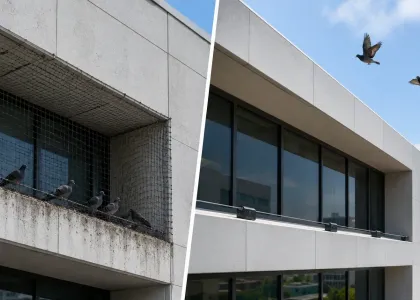
A commercial bird deterrent system helps facilities move beyond repeated cleanup by reducing the conditions that allow birds to keep returning to the same high-risk areas.
Why Bird Control Belongs in Facility Planning
Bird control should not be treated as a cleanup task only. For commercial properties, bird activity can affect roof systems, signage, solar panels, HVAC units, loading docks, walkways, drainage, and customer-facing areas.
When bird prevention is included in facility planning, teams can reduce emergency cleanup, protect critical assets, and avoid repeat service calls. This helps maintenance teams shift from reacting to visible damage to preventing the conditions that allow birds to return.
Facilities that treat bird control as infrastructure can also make better budget decisions. Instead of paying for the same problem repeatedly, they can reduce repeated bird control costs by investing in a long-term prevention strategy that supports cleaner, safer, and more predictable operations.
Commercial Assets Protected by Preventive Bird Control
Bird activity often spreads across more than one area of a property. For commercial and retail facilities, a preventive bird control plan should look at the full site, not only the most visible roosting location.
- Rooftops and parapets
- Solar panels and solar arrays
- HVAC units and mechanical areas
- Billboards, signage, and lighting systems
- Loading docks and warehouse openings
- Parking garages and customer walkways
- Drainage systems, gutters, and roof edges
- Food processing, retail, and industrial facilities
Turn Bird Control Into Preventive Infrastructure
Recurring cleanup and short-term deterrents can drain maintenance budgets without solving the root issue. Symterra helps commercial facilities build a long-term bird prevention strategy around asset protection, cost control, and operational reliability.
Request a Bird Prevention PlanWhy Monitoring Matters in Preventive Bird Control
Preventive bird control works best when facilities know whether their deterrent system is operating as intended. Understanding how behavior-based deterrence works also helps teams identify why weak coverage areas can go unnoticed until birds return and the cleanup cycle starts again.
Monitoring helps facility teams identify system issues, coverage gaps, and potential weak zones before bird activity becomes a larger maintenance problem. This supports faster response, better planning, and fewer recurring service interruptions.
For commercial buildings, this makes bird control easier to manage as part of routine facility oversight rather than another emergency maintenance task.
Where Bird Control Fits as Infrastructure
Safety Systems
Bird droppings create slip hazards, fire risks, and contamination. Preventive deterrents reduce these risks the same way guardrails and alarms do.
Asset Protection
Bird activity accelerates corrosion, clogs drains, damages HVAC systems, and shortens equipment life. Infrastructure-level bird control preserves capital assets.
Compliance and Risk Management
Facilities with food, healthcare, or industrial operations face strict standards. Preventive bird control supports compliance by reducing contamination and inspection failures.
Why Maintenance-Based Bird Control Always Falls Short
Timing Is Always Too Late
By the time maintenance responds, damage has already occurred. Droppings, nests, and corrosion are evidence of failure, not the start of the problem.
Inconsistent Coverage Invites Return
Maintenance actions happen intermittently. Birds exploit gaps between cleanups and quickly reestablish routines.
What Preventive Bird Control Looks Like in Practice
Designed Coverage Across High-Risk Zones
Preventive systems focus on ledges, beams, rooftops, loading docks, HVAC units, and electrical infrastructure before birds settle.
Continuous Operation Without Human Intervention
Once installed, the system works without relying on schedules, reminders, or emergency calls.
Monitoring Instead of Guesswork
Infrastructure requires visibility. Knowing when systems weaken prevents failure instead of reacting to it.
Infrastructure Only Works When It Is Verified
Treating bird control as preventive infrastructure changes outcomes. Instead of repeating cleanup cycles, facilities reduce risk, protect assets, and stabilize operating costs. The difference lies in consistency and verification.
Symterra Pulse supports this approach by providing real-time visibility into deterrent system performance. It identifies weak zones and faults before birds reestablish themselves. With verified operation, bird control functions as true infrastructure rather than another recurring maintenance task.
Need a Long-Term Bird Prevention Strategy?
Symterra helps facilities move away from repeated cleanup and toward long-term prevention. Request a site recommendation to understand how bird control can support maintenance planning, asset protection, and cost control.
Request a Site RecommendationFrequently Asked Questions About Preventive Bird Control
What does preventive bird control mean?
Preventive bird control means stopping bird activity before it creates recurring cleanup, property damage, safety issues, or maintenance disruption. It focuses on long-term prevention instead of one-time reaction.
Why should bird control be part of facility maintenance planning?
Bird control should be part of facility maintenance planning because bird activity can affect rooftops, solar panels, signage, HVAC systems, walkways, drainage, and customer-facing areas.
How does preventive bird control reduce maintenance costs?
Preventive bird control reduces maintenance costs by limiting repeated cleanup, nest removal, contractor visits, asset repair, and emergency service calls caused by recurring bird activity.
Why do reactive bird control methods become expensive?
Reactive methods become expensive because they address the visible problem after birds return. If the site still attracts birds, the same cleanup, repair, and service costs continue repeating.
When should a facility consider a long-term bird prevention plan?
A facility should consider a long-term bird prevention plan when bird problems return after cleanup, affect maintenance schedules, create safety concerns, or begin increasing operational costs.