Table of Contents
- Quick Answer
- Do DIY Bird Deterrents Actually Work for Commercial Buildings?
- The Hidden Costs of DIY Bird Control for Commercial Properties
- What Determines Commercial Bird Control Costs?
- Liability, Compliance, and Legal Risks
- Why Cheap Bird Deterrents Cost More in the Long Run
- Why DIY Bird Control Fails to Solve the Root Cause
- Why Long-Term Bird Control Delivers Better ROI
- The Best Bird Control Strategy for Commercial Buildings
- Why DIY Bird Deterrents Create a False Sense of Security
- Why Symterra Pulse Outperforms DIY Bird Deterrents
- Stop Paying for Recurring Bird Damage and Cleanup Costs
- Frequently Asked Questions About DIY Bird Deterrents
- Why do DIY bird deterrents keep failing for commercial buildings?
- What are the hidden costs of DIY bird control?
- Is professional bird control worth it compared to DIY?
- What damage do birds cause to commercial buildings over time?
- Why do cheap bird deterrents cost more in the long run?
- What should a commercial facility look for in a bird control solution?
DIY bird deterrents often look affordable at first. Reflective tape, plastic owls, spikes, gels, and low-cost netting seem like quick ways to move birds away from a building.
The problem is that most DIY products only move the issue. They do not address why birds chose the site in the first place.
For commercial buildings, failed DIY bird control creates hidden costs through repeated cleanup, roof and gutter damage, HVAC issues, liability exposure, and constant replacement. What starts as a cheap fix often becomes a long-term maintenance problem.
Quick Answer
Why do DIY bird deterrents fail for commercial buildings?
DIY bird deterrents often fail because they only treat visible bird activity in small areas. Reflective tape, plastic owls, gels, spikes, and low-cost netting may work briefly, but birds can adapt, relocate, or return when the deterrent weakens. For commercial buildings, failed DIY bird control can increase cleanup, repair, liability, and long-term maintenance costs.
Do DIY Bird Deterrents Actually Work for Commercial Buildings?
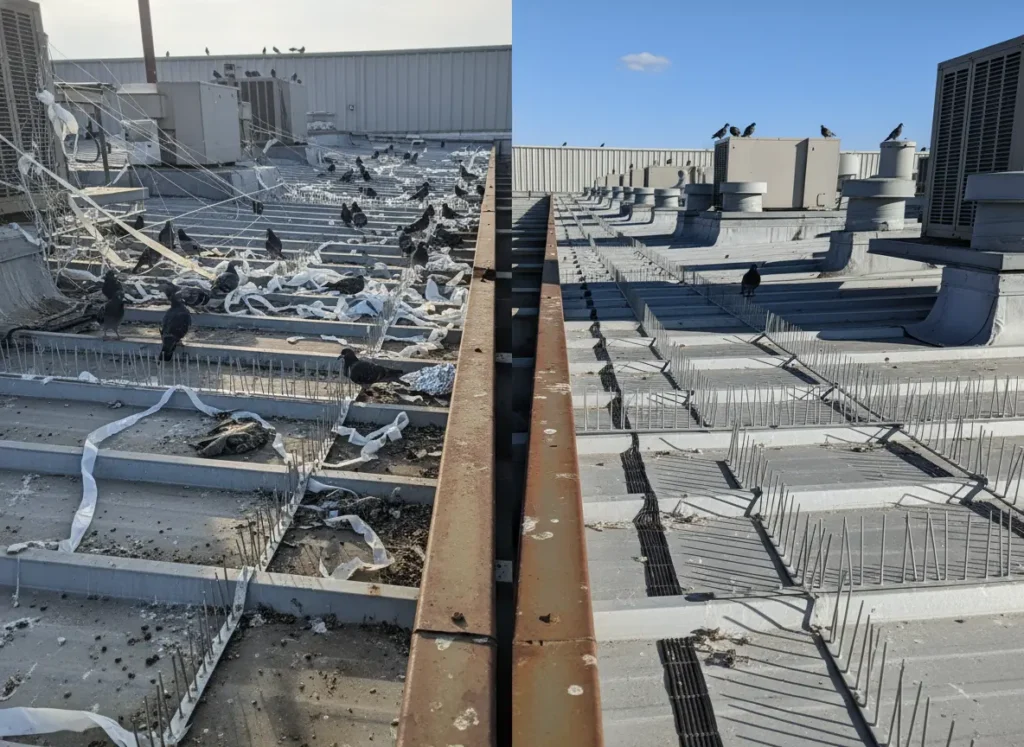
DIY bird deterrents may work for a short time in small, low-risk areas. They usually fail on commercial buildings because birds adapt, move to nearby surfaces, or return when the deterrent weakens.
Common DIY methods fail because they:
- Cover only one small area
- Do not change bird behavior long term
- Require constant inspection and replacement
- Leave nearby ledges, signs, vents, and rooflines exposed
- Create a false sense of protection
For commercial properties, the issue is rarely one perch. It is usually a pattern across multiple building zones.
The Hidden Costs of DIY Bird Control for Commercial Properties
1. How DIY Bird Deterrents Cause Property and Infrastructure Damage
Birds can cause extensive damage when deterrents are installed incorrectly or left unmaintained. Without a complete bird proofing strategy, nests, droppings, and feathers can build up in hidden areas and cause significant problems such as:
- Roof and gutter clogging that leads to leaks and standing water.
- HVAC contamination and vent blockage issues that spread dust, odors, and bacteria.
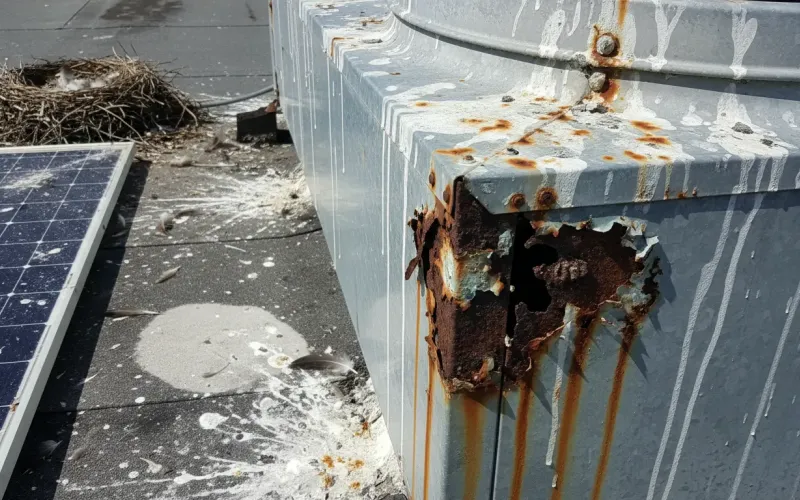
- Structural corrosion from droppings, as acidic bird droppings slowly eat through paint, sealants, and metal.
- Signage and electrical damage caused by nesting near lighting or wiring systems.
Over time, this buildup can lead to bird-related property erosion and expensive bird damage repairs.
2. Health and Safety Risks of Failed Bird Deterrents
Unmaintained deterrents and poor bird-proofing maintenance can turn into serious health and safety concerns. Dried droppings and feathers carry harmful pathogens that affect air quality and can trigger respiratory issues.
Businesses also face:
- Slip and fall liability from droppings near walkways and entry points.
- Health hazard oversight if droppings contaminate ventilation or food storage areas.
- OSHA violations and regulatory fines for failing to maintain sanitary conditions.
A single slip fall injury claim or compliance fine can easily surpass the cost of professional bird control services.
3. How DIY Bird Deterrents Affect Building Appearance and Operations
DIY deterrents like reflective tape, plastic owls, or other visual devices may seem harmless, but they can create more problems than they solve.
- Visual deterrent misuse can make a building look unprofessional or neglected.
- Improper DIY installation often leaves gaps that allow birds to return.
- Poorly installed spikes or nets trap debris, which leads to energy inefficiency from nests and blocks airflow.
Low-quality commercial bird netting or bird spikes failure can also harm birds or damage property, resulting in wildlife compliance concerns and negative public perception.
4. The Ongoing Cost of Cleaning and Maintenance
Many DIY deterrents require constant cleaning and replacement. When unmaintained deterrents are left in place, acidic bird droppings accumulate and accelerate structural corrosion, which increases ongoing cleaning costs.
The hidden bird infestation costs include labor hours, cleaning supplies, equipment rentals, and downtime during cleanup. Over time, these recurring expenses add up to far more than the price of a professionally installed system.
Recurring cleanup is also one reason bird nesting increases maintenance costs for infrastructure owners.
What Determines Commercial Bird Control Costs?
The cost of bird control services for commercial property depends on how large the building is, how severe the bird activity has become, and what level of protection is needed. A property with light activity on a small roof will cost far less than a large facility with nesting, droppings, clogged drains, or damage near HVAC and electrical systems. In most cases, the real cost is not just the service itself. It is the cleaning, repairs, downtime, and liability that continue when bird problems are left unresolved.
5. Liability, Compliance, and Legal Risks
Property owners are legally responsible for keeping their buildings safe and hazard-free. Ignoring or mishandling infestations can result in serious bird infestation liability issues.
Common risks include:
- Bird-related fire hazards from nests near electrical systems.
- OSHA violations for health and safety breaches.
- Regulatory fines tied to sanitation and wildlife protection laws.
Without a proactive bird-proof maintenance plan, companies risk repeated violations, rising insurance costs, and damage to their reputation.
Why Cheap Bird Deterrents Cost More in the Long Run
DIY bird deterrents fail because they treat symptoms, not behavior. Birds adapt quickly, maintenance gets skipped, and problems spread to new areas like HVAC systems, signage, and rooflines. What looks affordable upfront turns into repeated cleaning, repairs, compliance risks, and liability exposure. Long-term bird control only works when prevention is built into the structure, not taped onto it.
DIY vs Professional Bird Control Comparison Table
| Factor | DIY Bird Deterrents | Professional Bird Control |
|---|---|---|
| Coverage | Usually protects one small area, such as a ledge, sign, or roof edge. | Evaluates the full site, including rooftops, loading docks, HVAC zones, signs, ledges, and customer areas. |
| Long-term effectiveness | Often weakens as birds adapt, products degrade, or the problem moves nearby. | Focuses on reducing repeat bird activity through a site-specific prevention strategy. |
| Maintenance | Requires frequent replacement, repositioning, cleaning, or repair. | Designed to reduce repeated maintenance cycles and recurring cleanup. |
| Risk control | Reactive and usually installed after birds have already caused damage. | Prevention-focused and built around reducing future damage, cleanup, and disruption. |
| Appearance | Can look temporary, messy, or inconsistent across commercial buildings. | Can support a cleaner building presentation with a more coordinated approach. |
| Total cost | Lower upfront cost but higher repeat costs if birds continue returning. | Higher planning value with stronger long-term cost control. |
Why DIY Bird Control Fails to Solve the Root Cause
Most DIY deterrents are reactive solutions. They focus on removing visible birds instead of addressing the root cause of the infestation. This reactive versus proactive control approach keeps businesses stuck in a cycle of temporary fixes and long-term expenses.
Professional bird exclusion systems take a proactive approach. They are designed to stop birds before they settle and combine multiple deterrents, such as electric track deterrents, bird exclusion solutions, and expert placement, for comprehensive coverage.
For a deeper look at why birds return after temporary deterrents, read our guide on lasting bird prevention depends on behavioral change.
Hidden Costs of DIY Bird Deterrents
| Hidden Cost | How It Happens | Business Impact |
|---|---|---|
| Repeated product replacement | Low-cost deterrents break, fade, loosen, or stop working. | Creates ongoing material and labor costs. |
| Recurring cleanup | Birds continue leaving droppings, feathers, and nesting debris. | Increases cleaning schedules and maintenance workload. |
| Building damage | Droppings, nests, and blocked drainage continue affecting roofs, signs, gutters, and equipment. | Can increase repair costs and shorten asset life. |
| Operational disruption | Cleanup or repair work blocks walkways, loading areas, roof access, or customer spaces. | Slows daily operations and creates scheduling issues. |
| Safety and liability exposure | Droppings collect near entrances, walkways, parking areas, or employee access points. | Creates slip-risk concerns and customer complaints. |
| Problem relocation | Birds move from treated areas to nearby untreated surfaces. | Forces the business to keep expanding temporary fixes. |
Why Long-Term Bird Control Delivers Better ROI
Choosing professional bird control is not just about keeping birds away. It is about protecting assets and preventing loss. An expert site assessment helps identify the problem areas before they cause costly damage or compliance issues. A tailored bird-proofing strategy ensures consistent results and protects property value.
This is where Symterra Pulse leads the way. Symterra Pulse uses behavior-based deterrence to make treated areas less attractive for repeated landing, roosting, and nesting. Unlike spikes, tapes, or gels, Pulse protects your entire building continuously using non-lethal, behavior-based bird deterrence or affecting your architecture.
It is the next generation of professional bird control services, built for long-term durability, low maintenance, and full regulatory compliance.
The Best Bird Control Strategy for Commercial Buildings
DIY deterrents may look affordable at first, but the hidden costs tell a different story. From cleaning costs and structural corrosion to slip and fall liability and OSHA violations, the real expenses continue to grow over time.
With Symterra Pulse, you can protect your property permanently. Our system delivers:
- Continuous protection against droppings and nesting.
- Reduced maintenance and repair costs.
- Compliance with OSHA and environmental standards.
- A clean, professional appearance with no visible hardware.
Stop reacting to infestations and start preventing them. Contact Symterra today for an expert site assessment and discover how Pulse can safeguard your property for years to come.
If the issue affects multiple rooftops, ledges, docks, or equipment zones, bird control at scale may be the better framework.
Why DIY Bird Deterrents Create a False Sense of Security
Many property managers assume that once a DIY deterrent is installed, the problem is solved. In reality, most low-cost devices create a false sense of security. They might work for a few days or weeks, but birds quickly learn to ignore stationary objects, predictable noises, or weak barriers.
This false confidence causes two major issues:
- Delayed intervention
Building owners believe the site is protected, so inspections slow down. By the time nests, droppings, or blockages are discovered, the damage has already spread. - Hidden system strain
Birds that return after deterrent failure often target new spots, including HVAC intakes, signage brackets, and roof valleys. This increases the risk of corrosion, overheating, and mechanical breakdowns.
When these delayed problems surface, repairs cost far more than the price of a proper bird management plan. That is why proactive, professionally engineered solutions consistently outperform DIY tactics. They remove uncertainty and provide predictable results that protect commercial assets long-term.
Why Symterra Pulse Outperforms DIY Bird Deterrents
Traditional deterrents rely on visual scare tactics or physical barriers. Birds adapt to these quickly, especially in commercial environments with abundant shelter.
Symterra Pulse’s electromagnetic technology changes the equation by:
- Creating a consistent, non-harmful sensory field birds want to avoid
- Protecting entire surfaces, not just small sections
- Eliminating the need for spikes, nets, or bulky visual devices
- Maintaining effectiveness without constant repositioning or cleaning
- Working 24/7, regardless of weather, heat, or building design
This makes Pulse ideal for rooftops, ledges, signs, HVAC units, and other hard-to-protect surfaces where birds usually persist.
Request a Commercial Bird Control Recommendation
If your team keeps buying deterrents, cleaning the same areas, or moving birds from one part of the property to another, the issue may need more than a DIY fix.
Symterra can help evaluate where birds are returning, what risks they are creating, and whether a behavior-based prevention strategy is a better long-term fit for your site.
When DIY Bird Control Becomes a Commercial Facility Problem
DIY deterrents may be enough for a small, low-risk area, but commercial properties need a stronger strategy when bird activity affects multiple zones. Common problem areas include rooftops, signs, ledges, loading docks, HVAC equipment, parking areas, and customer-facing entrances.
Facilities can learn more about Symterra Pulse and how behavior-based bird deterrence works. Symterra also supports commercial and retail facilities, industrial and warehouse facilities, and signs and billboards where DIY fixes often create repeat maintenance cycles.
Facility teams can also use the bird control cost calculator to compare recurring cleanup and repair costs with long-term prevention.
Frequently Asked Questions
Why do DIY bird deterrents keep failing for commercial buildings?
DIY bird deterrents keep failing because they usually cover only small areas and do not solve the reason birds are returning. Birds may adapt, move nearby, or return once the deterrent weakens. Commercial buildings often need a full-site strategy instead of isolated products.
What are the hidden costs of DIY bird control?
The hidden costs include repeated product replacement, recurring cleanup, property damage, clogged drains, roof repairs, stained signage, safety concerns, customer complaints, and labor spent managing the same problem again and again.
Is professional bird control worth it compared to DIY?
Professional bird control is often worth it for commercial and industrial properties because it evaluates the full site and focuses on long-term prevention. The upfront planning may be higher, but it can reduce repeated cleanup, repairs, replacement products, and disruption over time.
Why do cheap bird deterrents cost more in the long run?
Cheap bird deterrents can cost more because they often fail, degrade, or only move birds to nearby areas. The business may continue paying for cleanup, repairs, inspections, product replacement, and labor even after buying multiple deterrents.
What should a commercial facility look for in a bird control solution?
A commercial facility should look for a bird control solution that addresses the full site, reduces repeated bird activity, limits maintenance dependency, supports compliance needs, and protects areas such as roofs, signs, loading docks, parking areas, ledges, and equipment zones.
When should a facility stop using DIY bird deterrents?
A facility should move beyond DIY deterrents when birds keep returning, cleanup repeats in the same areas, deterrents need constant replacement, or bird activity affects safety, appearance, operations, or maintenance costs.