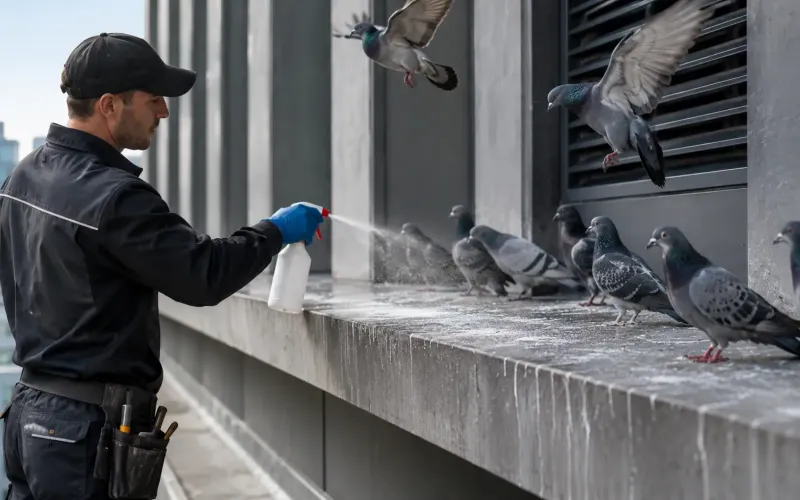
Bird repellent sprays are often marketed as a quick way to keep birds away from buildings, rooftops, signs, ledges, and outdoor equipment. At first, they may seem like a simple fix. Apply the product, create an unpleasant surface or scent, and wait for birds to leave.
The problem is that bird activity around commercial properties is rarely solved by a temporary surface treatment. Birds return to specific locations because those areas offer food, shelter, warmth, nesting access, visibility, or protection from predators. When the reason for the activity remains, sprays usually become a short-term reaction instead of a long-term bird control strategy.
For facilities dealing with recurring bird problems, repellent sprays often fail because they do not change bird behavior in a lasting way.
Quick Answer
Bird repellent sprays fail for long-term bird control because they have short active lifespans, wear off under weather exposure, and do not remove the root attraction that brings birds back. Birds can also adapt through site habituation when the threat does not remain consistent. Long-term bird control requires behavioral change, full coverage, and a strategy that makes the site feel unreliable for birds over time.
Why Facilities Use Bird Repellent Sprays for Quick Control
Bird repellent sprays are commonly used because they appear simple, affordable, and easy to apply. Property managers may use them on ledges, beams, rooftops, signage, loading areas, or other surfaces where birds land.
Most sprays are designed to make surfaces uncomfortable, sticky, slippery, bitter, or unpleasant. Some products rely on scent or taste. Others try to discourage birds from landing by creating an irritating surface.
These methods may reduce activity for a short period, but they usually struggle when birds are already attached to the site.
Why Bird Repellent Sprays Lose Effectiveness Quickly
One of the biggest reasons bird repellent sprays fail is their short active lifespans. Most sprays do not remain effective indefinitely.
Outdoor conditions can break them down quickly. Rain, wind, dust, heat, direct sunlight, cleaning schedules, and surface wear can reduce their impact. In commercial environments, this creates a constant maintenance cycle.
A spray may need to be reapplied again and again to keep working. If reapplication is missed, delayed, or applied unevenly, birds may return quickly.
For facility teams, this creates three problems:
- The bird control effect is temporary.
- Labor and maintenance costs continue.
- Coverage becomes inconsistent across the site.
When a bird deterrent depends on repeated application, it becomes hard to manage at scale.
How Site Habituation Makes Bird Sprays Less Reliable
Birds are highly adaptive. If they encounter a repellent spray but continue to find food, shelter, or nesting opportunities nearby, they may test the area again.
This is called site habituation. Over time, birds can become less responsive to a deterrent when it does not create a consistent risk or meaningful change in the environment.
For example, birds may avoid a treated ledge for a few days, then return when the scent fades or the surface changes. If the spray only affects one area, they may simply move to another nearby landing spot on the same building.
This is why sprays often create displacement instead of resolution. The birds do not leave the property. They just adjust their behavior.
Bird Repellent Sprays Do Not Address the Root Attraction
Birds do not choose commercial sites randomly. They return because something about the property supports their routine.
Common root attractions include:
| Root Attraction | Why Birds Return |
| Food sources | Open waste areas, spills, nearby feeding zones, or outdoor dining areas |
| Shelter | Covered beams, signs, canopies, rooftop units, and protected corners |
| Nesting access | Gaps, ledges, rafters, and hidden spaces with low disturbance |
| Safe vantage points | Elevated areas where birds can observe activity and predators |
| Habit and routine | Birds return to places they already associate with safety and reward |
Repellent sprays may affect a surface, but they do not remove these underlying conditions. If the site still feels useful to birds, the pressure to return remains.
This is especially important for commercial properties, food facilities, warehouses, retail centers, utility structures, parking areas, and rooftops where bird activity can become an operational issue.
Bird Repellent Sprays Do Not Provide Full Property Coverage
Another major weakness of repellent sprays is limited coverage. Bird problems often involve multiple landing, roosting, and nesting zones across a property.
A treated ledge may discourage birds from one spot, but it does not protect the entire structure. Birds may shift to nearby signage, HVAC units, roof edges, gutters, lighting fixtures, parapets, or loading dock beams.
This creates a patchwork problem. Facility teams treat one area, then birds move to another. The site still has bird activity, but now the issue becomes harder to predict.
Full coverage matters because birds respond to the entire environment, not just one treated surface.
Why Physical Deterrents Alone Are Not Enough
Some facilities try to solve spray failure by adding physical alteration, such as spikes, netting, wires, or barriers. These methods can help in specific areas, but they also come with limitations.
Physical deterrents often require regular inspection, cleaning, repair, and replacement. Birds may build around them, move beside them, or shift to nearby untreated areas. On large or complex properties, physical systems can also create access issues for maintenance teams.
Physical alteration may block one behavior, but it does not always change the broader decision-making pattern that keeps birds attached to a site.
For long-term success, facilities need to think beyond surface treatment and spot blocking.
Long-Term Bird Control Requires Behavioral Change
The most effective bird control strategies focus on long-term behavioral change. Instead of relying only on sprays, sticky surfaces, or fixed barriers, the goal is to make the site feel unreliable and undesirable to birds over time.
Birds make decisions based on comfort, safety, access, and reward. When those signals change consistently, birds are more likely to abandon a location and establish new routines elsewhere.
This approach works because it targets how birds behave, not just where they land.
A behavior-based strategy should focus on:
| Control Goal | Why It Matters |
| Reduce comfort | Birds are less likely to stay where conditions feel unstable |
| Interrupt routine | Repeated disruption weakens site attachment |
| Limit reward | Birds stop returning when food, shelter, or nesting benefits decline |
| Maintain consistency | Continuous pressure prevents birds from retesting the site |
| Expand coverage | Wider protection reduces displacement to nearby areas |
Consistent Deterrence Is Required for Long-Term Bird Control
Birds often return when deterrents become predictable, inconsistent, or inactive. This is why one-time spray treatments rarely solve recurring bird problems.
Long-term bird control requires a system that remains active, covers the right areas, and responds to the way birds use the site. Without consistency, birds may simply wait out the deterrent or return when conditions improve.
For commercial properties, consistency is especially important because bird activity can affect:
| Business Area | Potential Impact |
| Maintenance | More cleanup, repairs, and service calls |
| Safety | Slip hazards, blocked access, and worker exposure |
| Equipment | Droppings, debris, and nesting near mechanical systems |
| Brand image | Unsightly entrances, signage, sidewalks, and customer areas |
| Operations | Delays, contamination concerns, and recurring downtime |
Bird control should not become another repeating maintenance task. It should reduce the need for reactive cleanup and constant retreatment.
When Bird Repellent Sprays May Still Help
Bird repellent sprays are not always useless. They may provide temporary support in limited situations, especially when bird pressure is low or when the goal is short-term surface discouragement.
However, sprays should not be treated as the main solution for recurring bird activity. They work best as a small part of a broader strategy, not as the foundation of long-term control.
If birds keep returning after repeated spray applications, the issue is no longer just a surface problem. It is a site behavior problem.
A Better Long-Term Strategy for Commercial Bird Control
For facilities with recurring bird activity, the better question is not “What can we spray?”
The better question is “Why are birds choosing this site, and how do we change that behavior?”
A long-term bird control plan should identify:
- Where birds are landing, roosting, and nesting
- What is attracting them to the site
- Whether the problem involves food, shelter, safety, or routine
- Which areas need full coverage
- How to create consistent behavioral pressure without relying on constant reapplication
This type of strategy helps facilities move away from temporary treatment and toward prevention.
Request a Commercial Bird Control Site Recommendation
Bird repellent sprays often fail because they only treat the surface. Symterra helps facilities address bird activity by focusing on long-term behavioral change, site coverage, and recurring bird pressure across commercial and industrial environments.
For Industrial and Warehouse Facilities, recurring bird activity can affect loading docks, rooflines, equipment areas, inventory zones, and employee walkways. For signs and billboards, birds may return to elevated frames, lighting fixtures, support structures, and sheltered areas behind panels.
If birds keep returning after sprays, barriers, or other short-term deterrents, it may be time to evaluate the site differently.
Contact Symterra to request a site recommendation for Industrial and Warehouse Facilities, signs and billboards, rooftops, parking structures, retail properties, and other commercial sites where long-term bird control is needed.
Frequently Asked Questions About Bird Repellent Sprays
Why do bird repellent sprays stop working?
Bird repellent sprays stop working because they break down over time, lose strength under weather exposure, and require frequent reapplication. Birds may also adapt if the site still provides food, shelter, or nesting access.
Are bird repellent sprays good for long-term bird control?
Bird repellent sprays are usually not ideal for long-term bird control when bird activity is recurring. They may help temporarily, but they do not usually address the root attraction that brings birds back.
What does site habituation mean in bird control?
Site habituation happens when birds become used to a deterrent and stop reacting to it. If a spray does not create a lasting change in the environment, birds may return and continue using the site.
Why do birds return after spray treatment?
Birds return after spray treatment when the location still offers safety, shelter, food, or nesting opportunities. If the underlying attraction remains, birds may wait until the spray fades or move to another nearby area.
What is better than bird repellent spray for commercial properties?
A long-term bird control strategy that focuses on behavioral change, full coverage, and consistent site pressure is usually better for recurring bird problems. This approach targets why birds return instead of only treating where they land.