Table of Contents
- Quick Answer
- How Bird Spikes Prevent Birds From Landing
- Limitations of Bird Spikes for Long-Term Bird Control
- Why Bird Spikes Often Fail Against Small Birds
- How Electromagnetic Bird Deterrents Work
- Bird Spikes vs Electromagnetic Deterrents: The Key Difference
- Which Bird Control Solution Lasts Longer for Commercial Properties?
- Frequently Asked Questions
Bird spikes are the most recognized bird control product on the market. Walk past any commercial building in a city and you will see them on ledges, parapets, and rooflines. They are cheap, widely available, and easy to understand.
Electromagnetic deterrents are newer, harder to explain, and work at a completely different level.
This post compares both on the thing that matters most for a commercial facility: which one holds up over time.
Quick Answer
Bird spikes work best for narrow ledges and small landing zones, while electromagnetic deterrents are better suited for larger commercial facilities with recurring bird activity. Spikes physically block specific surfaces, but they require full coverage and ongoing maintenance. Electromagnetic deterrents help reduce return behavior by making the site less comfortable for birds to settle in long term.
How Bird Spikes Prevent Birds From Landing
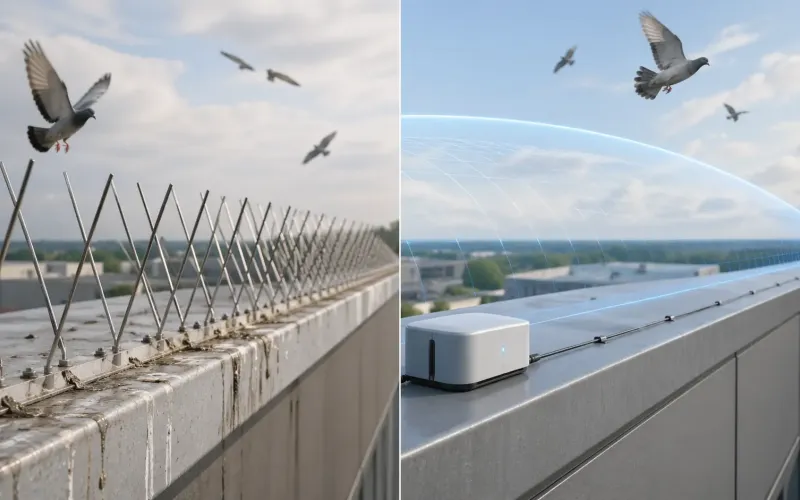
Bird spikes are strips of blunted metal or plastic rods installed on surfaces where birds land. The rods break up flat ground, making it difficult for larger birds to get stable footing. The idea is purely mechanical: no flat surface, no landing, no roosting.
They work for what they are designed to do. Pigeons, gulls, and crows need a solid platform to land, and spikes take that away. For a narrow window ledge or a parapet wall, spikes are a proven solution.
The problems start when you move beyond a simple ledge.
Limitations of Bird Spikes for Long-Term Bird Control
Installation Gaps Reduce Bird Spike Effectiveness
Spikes only work where they are installed, and installation is where most systems fail. If there are gaps between spike sections, birds will find them. A few inches of unprotected surface is enough for a bird to land, and once one establishes a foothold, the flock follows.
Improper installation is one of the top reasons bird spikes fail across commercial properties. The rods need to cover the full width of a ledge with tips extending past the exposed edge. Wide surfaces need multiple rows. Corners, curves, and irregular geometry create natural gaps that standard strips cannot cover cleanly.
Debris Buildup Causes Bird Spike Failure
Even a correctly installed spike system does not stay that way. Leaves, twigs, dirt, and nesting material build up between the rods over time. Once that debris packs in, the spikes become a raised foundation that birds land on rather than an obstacle they avoid.
This is one of the most common failure patterns on commercial rooftops and it happens silently. The system looks intact from the ground while it has already stopped working.
Bird Spikes Move Birds Instead of Solving the Problem
Spikes move birds off one surface. They do not move birds off the property. A flock that can no longer land on the treated ledge will shift to the untreated HVAC unit, the rooftop edge, the sign frame, or the loading dock overhang. The facility still has a bird problem. It just moved six feet.
Bird Spikes Require Ongoing Maintenance
Spikes are not a set-and-forget solution. They require inspection at least twice a year to check for debris buildup, bent rods, adhesive failure, and loose strips. On high rooflines and complex structures, that inspection requires access equipment and labor. For a facility manager running multiple sites, that adds up.
When Physical Bird Barriers Create Maintenance Problems
Physical bird barriers can solve a narrow landing issue, but they can also create maintenance problems when used across larger commercial structures. Bird spikes collect leaves, twigs, dirt, and nesting material. Once debris fills the gaps between rods, the spikes may become a platform instead of a deterrent.
Maintenance crews also need safe access to inspect, clean, and repair spike systems. On rooftops, parapets, signage, and elevated structures, this can require lifts, roof access, extra labor, and repeated service visits. If one section loosens, bends, or leaves a gap, birds can return to the same area or shift to a nearby untreated surface.
For facilities with recurring bird pressure, this is where a physical barrier can become a long-term maintenance dependency instead of a complete solution.
Why Bird Spikes Often Fail Against Small Bird
Bird spikes work on larger species like pigeons and gulls. Smaller birds such as sparrows and starlings can perch between the rods or nest around them. Spikes installed at too wide a spacing for the target species actually give small birds a structure to build into, which makes the problem worse.
How Electromagnetic Bird Deterrents Work
Electromagnetic deterrents operate differently at the root level. Birds navigate using the earth’s magnetic field. Electromagnetic systems disrupt that signal, interfering with the bird’s ability to read the location as safe or navigable.
The result is not that birds are blocked from landing. The result is that birds stop wanting to come back. The biological signal that tells the flock the site is a safe roost is interrupted, and that message spreads through the group. For commercial properties with repeat bird pressure, an electromagnetic bird deterrent system can support broader coverage than physical barriers that only protect specific surfaces.
Electromagnetic deterrent systems have the strongest evidence base for long-term effectiveness in commercial environments. Facility managers can also review how electromagnetic bird deterrents work to understand why this approach focuses on bird navigation and return behavior instead of only blocking landing surfaces. Unlike physical barriers that degrade or auditory devices that birds habituate to, electromagnetic systems interfere with birds’ navigation at a biological level.
Bird Spikes vs Electromagnetic Deterrents: The Key Difference
This is where the comparison becomes straightforward.
Spikes displace birds. They remove the ability to land on one specific surface. Birds that are displaced are still looking for a roost. They adapt, they explore, and they eventually find the next available spot on the same property.
Electromagnetic deterrents remove the biological comfort signal that makes birds choose a location. A bird that cannot read a site as safe has no reason to stay near it. The flock communicates that signal and the site stops being a destination.
Spikes address access. Electromagnetic systems address intent.
| Factor | Bird Spikes | Electromagnetic Deterrents |
|---|---|---|
| Primary function | Blocks birds from landing on specific surfaces | Helps make the area less desirable for birds to return |
| Best use case | Narrow ledges, signs, beams, and small landing zones | Commercial rooftops, warehouses, towers, food facilities, parking garages, and large structures |
| Coverage | Only works where installed | Supports broader site-level deterrence |
| Maintenance | Requires cleaning, inspection, and repair | Designed for lower ongoing maintenance compared with physical barriers |
| Bird adaptation risk | Birds may move to nearby untreated areas | Targets return behavior instead of only blocking one surface |
| Long-term value | Useful for limited surfaces but can become maintenance-heavy | Better fit for facilities with recurring bird pressure |
Best Fit by Facility Type
| Facility or Surface | Better Fit | Why |
|---|---|---|
| Small ledges and signs | Bird spikes | Spikes can block simple, narrow landing points when installed correctly. |
| Commercial rooftops | Electromagnetic deterrents | Large roof areas are difficult to protect with physical barriers alone. |
| Warehouses and industrial facilities | Electromagnetic deterrents | Birds often move between rooflines, beams, docks, and equipment areas. |
| Parking garages | Electromagnetic deterrents | Recurring bird activity usually affects multiple levels, beams, ledges, and signs. |
| Utility towers and elevated structures | Electromagnetic deterrents | Access challenges make physical barrier maintenance harder and more expensive. |
Compare Symterra Pulse With Traditional Bird Deterrents
Not sure whether bird spikes, netting, or an electromagnetic bird deterrent system is the better fit for your facility? Symterra can help compare long-term coverage, maintenance needs, and performance based on your site layout.
Request a ComparisonWhich Bird Control Solution Lasts Longer for Commercial Properties?
For a single narrow ledge at a residential property, spikes are a reasonable and cost-effective choice when properly installed and maintained.
For a commercial facility: a warehouse, a telecom tower, a food processing plant, a billboard structure, or a flat industrial rooftop, the math changes. To compare long-term maintenance and coverage costs, facility teams can use the bird deterrent cost calculator before choosing between spikes and a broader deterrent system. These sites have complex geometry, large surface areas, high-access challenges, and year-round bird pressure from established flocks with strong site loyalty.
Spikes require coverage of every exposed surface, ongoing inspection, and regular maintenance. Any gap or neglected section reintroduces the problem. Electromagnetic systems require no physical coverage of the structure and address the biological reason birds are there in the first place.
For short-term, localized protection on simple surfaces: spikes work.
For a lasting result on a commercial site where bird pressure is real and ongoing: the approach that works at the behavioral and neurological level is the one that does not require the facility to win every maintenance cycle just to hold the line.
Frequently Asked Questions About Bird Spikes vs Electromagnetic Deterrents
Are bird spikes or electromagnetic deterrents better?
Bird spikes are better for small, narrow landing areas. Electromagnetic deterrents are better for larger commercial properties where birds return across multiple zones.
Do bird spikes require maintenance?
Yes. Bird spikes need regular inspection and cleaning because debris, nesting material, bent rods, and loose sections can reduce their effectiveness.
Do birds adapt to bird spikes?
Birds may not adapt to the spikes directly, but they often move to nearby untreated areas. This means the bird problem can continue on another part of the same property.
Are electromagnetic deterrents better for commercial buildings?
Electromagnetic deterrents are often a better fit for commercial buildings with rooftops, beams, equipment areas, signage, and recurring bird activity across multiple surfaces.
When should a facility replace bird spikes?
A facility should consider replacing or supplementing bird spikes when birds keep returning, debris builds up, maintenance costs increase, or the problem spreads to other parts of the property.