Table of Contents
- Quick Answer
- Why Crows Are So Difficult to Get Rid Of
- What Attracts Crows to Your Property?
- Problems Crows Cause for Homes and Businesses
- Why Most Crow Control Methods Fail
- Best Ways to Get Rid of Crows Permanently
- Common Places Where Crows Gather and Roost
- Crow Deterrents That Usually Fail Long Term
- How to Prevent Crows From Returning
- When Professional Crow Control Is Needed
- Long-Term Crow Control Requires a Complete Strategy
- Frequently Asked Questions
Crows are not easy to scare off.
They are highly intelligent, social, and quick to learn patterns. If a method fails once, they remember. If a location works for them, they return.
That is why many crow problems keep coming back.
If you want real results, you need a strategy that removes what attracts them, blocks their behavior, and makes your property consistently uncomfortable for them to stay.
That is the approach used by Symterra. The goal is not to chase birds. The goal is to change the environment so they choose to leave.
This guide explains what works and what does not when dealing with crows.
Quick Answer: How Do You Get Rid of Crows?
The best way to get rid of crows is to remove food sources, block nesting and roosting areas, and use a property-wide deterrent system that makes the area uncomfortable for them to return. Crows adapt quickly, so long-term control works best when prevention, exclusion, and active deterrence work together.
Why Crows Are So Difficult to Get Rid Of
Crows are different from most nuisance birds.
They do not rely only on instinct. They learn from experience and from each other.
- They recognize faces and remember threats
- They communicate safe locations to other crows
- They test and adapt to deterrents
- They return to reliable food and nesting areas
If your solution is predictable or inconsistent, crows figure it out fast.
What Attracts Crows to Your Property?
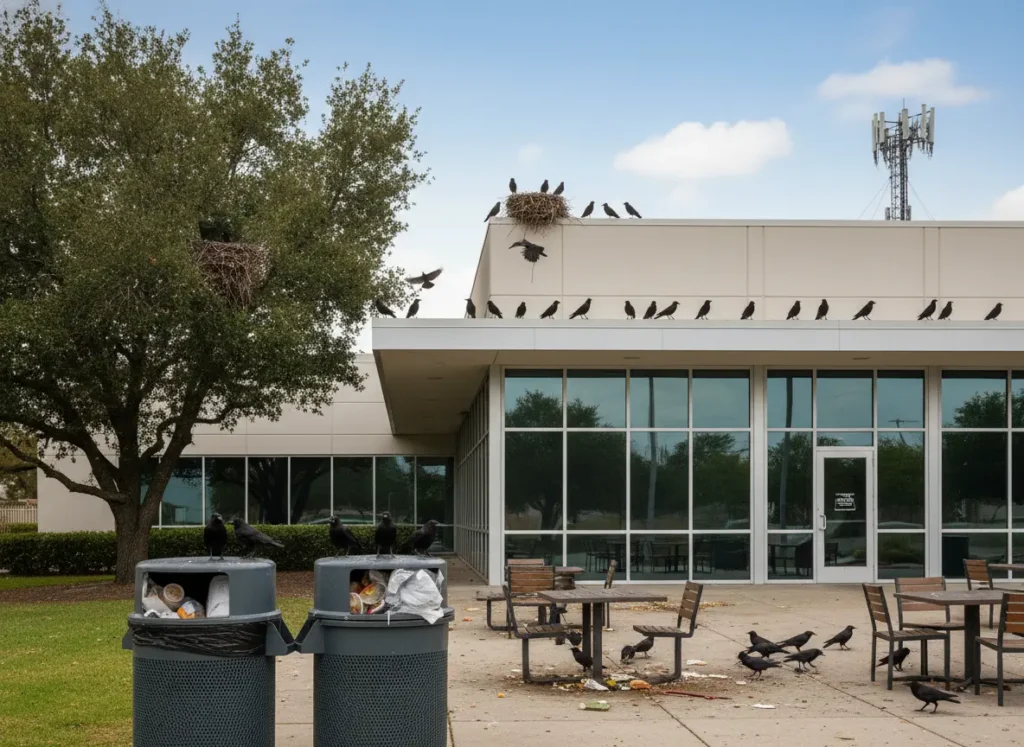
Crows look for three things:
- Food
- Shelter
- Safety
When your property provides all three, they stay.
Common attractors include:
- Open trash bins or food waste
- Outdoor eating areas
- Rooftop structures and ledges
- Trees near buildings
- Quiet, elevated nesting zones
Once crows settle, they bring others. What starts as a few birds can turn into a daily presence or a large roost.
Why Crows Keep Returning to the Same Property
Crows keep returning when a property gives them reliable food, shelter, visibility, and safety. Once they learn a location works, they remember it and often return with other crows.
This is why one-time scare tactics rarely solve the problem. If trash remains open, rooftop ledges stay available, or trees and structures provide safe roosting spots, crows will keep testing the property until they settle again.
Long-term crow control needs to change the conditions that made the property useful in the first place. That means removing attractants, reducing roosting access, and using a deterrent strategy that stays active over time.
Crow Control Options: What Works and What Fails
| Crow Control Option | How It Helps | Limitations | Best Use |
|---|---|---|---|
| Food Source Removal | Removes the main reason crows stay nearby | Does not solve roosting by itself | First step for any crow control plan |
| Netting or Exclusion | Blocks specific nesting or covered areas | Limited coverage on large open properties | Small covered zones or known nesting points |
| Fake Owls and Scare Devices | May create short-term movement | Crows learn they are not real threats | Temporary support only |
| Sound Deterrents | Can disrupt crow behavior at first | Predictable sounds become background noise | Short-term pressure with other methods |
| Property-Wide Deterrent System | Makes the area less stable for birds to settle | Requires site planning and proper coverage | Commercial properties, rooftops, loading areas, and recurring crow problems |
Need a Better Way to Keep Crows Away?
Symterra helps commercial properties reduce recurring crow activity with a prevention-focused bird deterrent system built for rooftops, loading areas, parking lots, signs, and large exterior spaces.
Explore Symterra Bird Deterrent SolutionProblems Crows Cause for Homes and Businesses
Crows create more than noise.
How Crows Damage Property
- Droppings damage surfaces and create constant cleanup
- Nesting debris clogs drains and gutters
- Pecking and movement affect equipment and fixtures
Safety Risks Caused by Crow Activity
- Slippery walkways from droppings
- Aggressive behavior during nesting season
- Increased risk in high-traffic areas
How Crows Affect Businesses and Commercial Properties
- Negative experience for customers and tenants
- Noise complaints
- Visible lack of property control
This becomes a recurring operational issue, not just a wildlife problem.
Why Most Crow Control Methods Fail
This is where most efforts break down.
Crows adapt faster than most bird species.
- Fake owls and predators lose effect quickly
- Noise devices become background sound
- Reflective objects stop working once birds get used to them
- Manual removal without follow-up does not stop return behavior
Crows learn patterns. If your deterrent does not change, they ignore it.
Best Ways to Get Rid of Crows Permanently
You need a layered approach. One method alone does not solve crow problems.
Remove Food Sources and Other Crow Attractants
Start with the basics.
- Secure trash bins with tight lids
- Clean food waste areas daily
- Remove standing water
- Limit open food sources around the property
If food stays available, crows stay.
This step is always the foundation of any plan, including how Symterra approaches bird control.
Block Crow Nesting and Roosting Areas
Next, reduce where crows can land and nest.
- Install spikes on ledges and signage
- Use netting in covered or structured spaces
- Trim trees near rooftops when possible
- Seal openings and sheltered cavities
This reduces the number of usable spots but does not eliminate activity on its own.
Use a Property-Wide Crow Deterrent System
This is where long-term control happens.
Crows do not leave because something looks different for a few days. They leave when the environment stops feeling stable.
A system like Symterra Pulse helps solve this problem.
Instead of relying only on visual or physical barriers, it changes how birds experience the space. When the environment feels inconsistent, crows avoid settling.
For large properties, rooftops, and commercial spaces, this type of approach works better than chasing birds from one area to another.
Combine Multiple Crow Control Methods for Best Results
The most effective setups combine:
- Attraction removal
- Physical exclusion
- Environmental deterrence
Each layer targets a different behavior.
Together, they reduce both current activity and future return.
Common Places Where Crows Gather and Roost
If you want faster results, focus on high-activity zones first.
- Rooftops and HVAC units
- Parking lots and open spaces
- Trash and disposal areas
- Trees near buildings
- Light poles and signage
- Loading docks
These areas give crows visibility, safety, and access to food.
Crow Deterrents That Usually Fail Long Term
Avoid relying on quick fixes.
- Static scare devices
- Occasional noise tools
- Random manual cleanup
- Partial deterrent coverage
These methods create temporary movement but rarely solve the problem.
Crows wait, adapt, and return.
How to Prevent Crows From Returning
Once you reduce crow activity, the goal is to keep it from rebuilding.
- Maintain clean waste areas
- Monitor rooftops and structures
- Remove early nesting attempts quickly
- Keep deterrent systems active
Crows return to locations that worked before.
Your job is to make sure they never work the same way again.
When Professional Crow Control Is Needed
If you are dealing with:
- Large crow populations
- Daily or seasonal roosting
- Multiple problem zones
- Commercial or industrial properties
You need more than manual control.
A system-wide strategy from Symterra helps manage bird pressure across the entire property, not just one section at a time.
Long-Term Crow Control Requires a Complete Strategy
Crows are smart. That is why simple solutions fail.
What works is a structured approach:
- Remove what attracts them
- Block where they land and nest
- Apply a deterrent that does not lose effect
- Maintain the system over time
If you rely on short-term fixes, the problem repeats.
If you control the environment, the behavior changes.
That is the strategy behind Symterra. Instead of reacting to crow activity, the focus is on preventing it with a consistent, property-wide approach.
Need a Better Way to Keep Crows Away?
Symterra helps commercial properties reduce recurring crow activity with a prevention-focused bird deterrent system built for rooftops, loading areas, parking lots, signs, and large exterior spaces.
Explore Symterra Bird Deterrent SolutionFrequently Asked Questions
Why are crows harder to get rid of than other birds?
Crows are highly intelligent and learn from experience. They remember successful feeding and nesting locations, recognize threats, and communicate information to other crows. This makes them more adaptable than many other nuisance bird species.
Why do crows keep coming back to the same property?
Crows return when a location consistently provides food, shelter, and safety. Once they identify a property as a reliable resource, they develop routines around it. If those conditions remain unchanged, the birds are likely to return repeatedly.
What attracts crows to commercial and residential properties?
Common attractants include open trash bins, food waste, outdoor eating areas, trees near buildings, and elevated nesting locations. Crows are opportunistic and quickly take advantage of easy resources. Removing these attractants is often the first step toward long-term control.
What problems do crows cause for property owners?
Crows create noise, leave droppings, and scatter nesting debris around the property. Their activity can damage surfaces, clog drainage systems, and create a negative impression for customers or visitors. In some cases, they may also become aggressive during nesting season.
Why do fake owls and scare devices stop working?
Crows quickly learn when a deterrent poses no real threat. Static decoys, repetitive sounds, and predictable scare tactics become familiar over time. Once crows determine the threat is not real, they ignore it.