Table of Contents
Real Bird Problems are Real. Really Real. The names have been changed to protect the innocent.
Quick Answer
Why did bird spikes and netting fail at this dry cleaner?
Bird spikes and netting failed at this dry cleaner because the birds adapted to the installed barriers and continued using the canopy as a safe roosting and nesting area. The deterrents addressed some landing surfaces, but they did not change the bird behavior that made the site attractive. Long-term bird control needs a strategy that addresses the structure, recurring roosting habits, and full-site bird pressure.
Bird Spikes and Netting Failure Table
| Failed control method | What it tried to solve | Why it failed |
|---|---|---|
| Bird spikes | Block birds from landing on selected surfaces | Birds nested around or on top of the spikes |
| Chicken wire or netting | Exclude birds from canopy gaps | Birds found weak points and continued using the structure |
| Object removal | Reduce food or nesting opportunities | Did not change the canopy’s shelter and roosting value |
| Cleanup alone | Remove droppings and nesting debris | Birds returned because the site still felt safe |
| Traditional pest control response | React to visible bird activity | Did not address recurring site behavior |
| Behavior-based deterrence | Change how birds experience the structure | Better suited for long-term prevention when birds keep returning |
Bird Control for Pest Bird Problems
As we’ve begun to introduce customers to bird control techniques and the Symterra technology, we’ve had NO SHORTAGE of stories about massive and multi-year bird infestations. Most common pest birds can be difficult to discourage with typical pest management solutions because they return to sites that provide shelter, height, food access, warmth, and nesting opportunities. Once a bird problem begins, it simply won’t end on its own. We encounter many a client/prospect at their wit’s end.
Case Study: A Busy Dry Cleaner Overrun by Birds
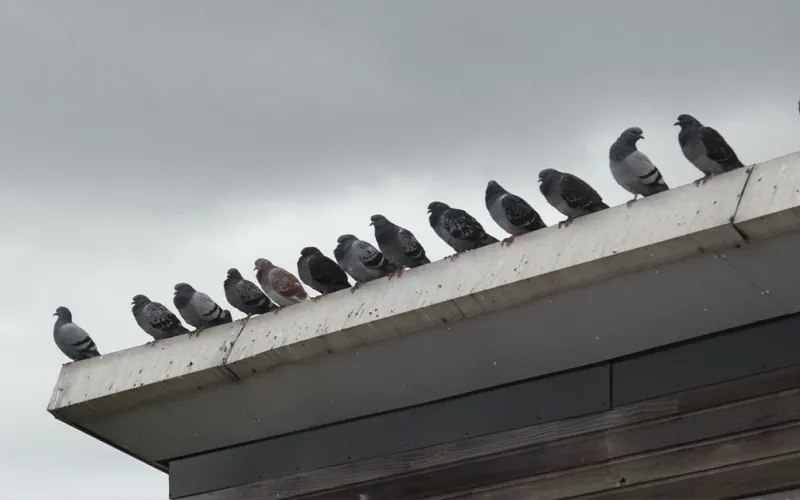
A prominent and successful dry cleaner reached out to their local pest management professionals about how to deter birds at their largest and busiest location. The building has a canopied drop-off/pick up area typical at any number of dry cleaners (You can see it, right?).
As patrons, we probably don’t pay much attention to our surroundings while we make that quick stop to claim our laundry…unless…unless you must shuffle through piles of the bird feces and nesting materials of common pest birds in orders to get to your clean clothes.
Why Dry Cleaner Canopies Attract Birds
Dry cleaner canopies can attract birds because they provide shelter, shade, height, and protection from weather. A covered drop-off and pickup area may also have beams, ledges, signs, lighting fixtures, and corners where birds can roost or nest with limited disturbance.
For customers and employees, the bird problem becomes visible through droppings, nesting material, odor, and walkway contamination. For the business owner, the issue becomes a recurring maintenance, safety, and customer experience problem.
When birds keep returning to the same canopy, the cause is usually not only one landing surface. The full structure may be giving birds several usable zones.
Why Bird Spikes and Netting Failed
That is the bird problem. The canopy is inundated with nesting birds and bird droppings, all roosting in the bird spikes and chicken wire previously installed to keep them out. Despite business’ best intentions, common pest control meant to eradicate feral pigeons, such as installing bird netting and removing any objects that could be used as bird feeders, often leave much to be desired.
The owner of the dry cleaner laments the time and dollars spent over the last few years to address the pest birds that never leave and continue to inundate their business with pest bird droppings despite all the efforts.
When Spikes and Netting Become Part of the Bird Problem
Bird spikes and netting can fail when birds learn how to work around them. If spikes are installed only on one surface, birds may land on nearby signs, beams, supports, or canopy edges. If netting or wire has gaps, sagging areas, or loose attachment points, birds may enter behind it and continue nesting.
In some cases, the deterrent itself becomes part of the nesting environment. Birds can use gaps, hardware, collected debris, or protected corners around the deterrent to stay in place.
For more detail on netting limitations, review Symterra’s guide on bird netting for commercial properties.
This is why product installation alone is not always enough. Long-term bird control should consider how birds move through the structure, where they feel protected, and which areas they keep testing after each cleanup.
Why Traditional Bird Control Methods Break Down
The canopy structure created a perfect roosting zone. Bird spikes and chicken wire were installed, but they only addressed where birds landed, not why they stayed. The birds adapted by nesting between and on top of the deterrents, turning the control devices into part of the problem. Without disrupting the birds’ behavior or attachment to the site, the infestation continued year after year.
For a broader explanation, read why static bird deterrents lose effectiveness when birds learn how to avoid predictable barriers.
Customer Safety and Business Risk From Recurring Bird Activity
For a dry cleaner, recurring bird activity can affect the customer experience immediately. Droppings near a pickup area, nesting debris around walkways, and visible bird activity above entrances can make the business look poorly maintained even when the interior service is professional.
There are also safety and property risks. Bird droppings can create slip hazards, contaminate walking surfaces, stain canopies, damage signs, and increase cleanup needs for employees or contractors.
For more information about exposure concerns, review Symterra’s guide on safety and health risks of bird droppings.
When the same issue continues for years, the cost is not only cleanup. It can affect customer confidence, employee safety, maintenance planning, and the business’s public-facing appearance.
A Smarter, Technology-Based Approach to Bird Control
Symterra is in a category of its own. The technology affects bird physiology. The system is designed to create a consistent, non-lethal deterrent experience that discourages birds from treating the protected area as a safe place to land, roost, or nest.
With this advancement, business owners can solve recurring bird problems without harming wildlife. Symterra Pulse offers an aesthetically pleasing, low-profile, and highly effective product that is easy to install and built to outperform traditional solutions.
Patron safety, employee safety, risk management and protection of assets are all improved!
Learn more about Symterra Pulse and how it supports long-term bird deterrence for commercial structures.
Bird Control Assessment
Bird Spikes and Netting Not Working?
If birds keep returning after spikes, netting, wire, cleanup, or short-term pest control, Symterra can help assess the structure and recommend a long-term bird control plan built around site behavior and recurring bird pressure.
Request a Bird Control AssessmentTo move beyond failed spikes, netting, and repeated cleanup, contact Symterra for a site recommendation.
Frequently Asked Questions About Pest Birds
What is a pest bird?
A pest bird is any bird that sets up camp where it shouldn’t and refuses to leave. Think pigeons, starlings, and sparrows nesting on buildings, canopies, and ledges. They cause property damage, create sanitation issues, and turn customer walkways into biohazard zones. These birds are not lost. They are comfortable. And once they’re comfortable, they stay.
Can exposure to bird droppings make you sick?
Yes. Full stop.
Bird droppings can carry bacteria, fungi, and parasites that pose real health risks to employees and customers. When droppings build up over time, they can contaminate surfaces, create slip hazards, and increase exposure to airborne pathogens. This is why long-term infestations are not just gross. They are a liability.
Is bird poop toxic to inhale?
It can be.
When bird droppings dry out, they can break into fine particles that become airborne. Inhaling these particles may expose people to harmful fungi and bacteria, especially in covered or enclosed areas like canopies. This is why bird infestations around entrances and pickup areas are a serious health concern, not just an eyesore.
Why do bird spikes fail?
Bird spikes can fail when birds land around the protected area, use nearby untreated surfaces, or build nesting material between or around the spikes. Spikes may help on narrow ledges, but they often do not solve full-structure bird pressure.
Why does bird netting fail?
Bird netting can fail when it sags, tears, collects debris, has weak attachment points, or leaves gaps where birds can enter. Once birds get behind the netting, they may continue roosting or nesting.
Why do birds keep returning after cleanup?
Birds keep returning after cleanup because the structure may still provide shelter, height, warmth, food access, or nesting opportunities. Cleanup removes droppings and debris, but it does not change the bird behavior causing the problem.